Florida Architecture

Celebrating Ralph Twitchell, Architect: With and Beyond Paul Rudolph

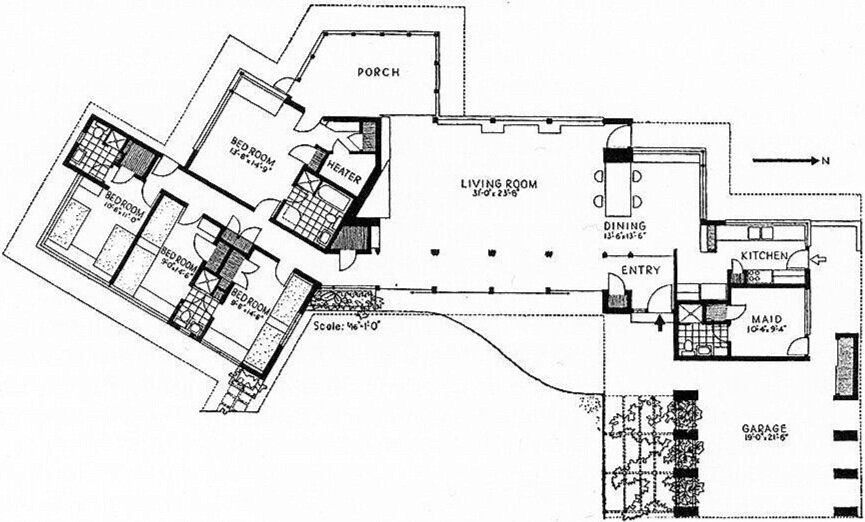
The plan of the Twitchell Residence: Ralph Twitchell’s residence in Sarasota, Florida, a design of 1941. It is Paul Rudolph’s second built design, and his first in association with the senior architect. What might one learn (or speculate about) from studying such a floor plan?
The plan of the Twitchell Residence: Ralph Twitchell’s residence in Sarasota, Florida, a design of 1941. It is Paul Rudolph’s second built design, and his first in association with the senior architect. What might one learn (or speculate about) from studying such a floor plan?

Ralph Spencer Twitchell, Architect (1890-1978)

Ralph Spencer Twitchell, Architect (1890-1978)

RALPH TWITCHELL

It is the birthday of Ralph Spencer Twitchell (July 27, 1890 – January 30, 1978)—and we take this moment to celebrate this architect, one who not only played a key part in the life and career of Paul Rudolph, but who contributed to the Sarasota community.

TWITCHELL AND RUDOLPH

Even to those who have a deep interest in the history of Modern architecture, Ralph Twitchell is not known much beyond a brief summary that peppers many biographies of Rudolph. What one often reads is that the senior architect gave Rudolph his start (Twitchell was nearly 3 decades older than Rudolph), bringing the young designer into his practice, and (and, as soon as Rudolph obtained his architectural license, taking him into partnership).

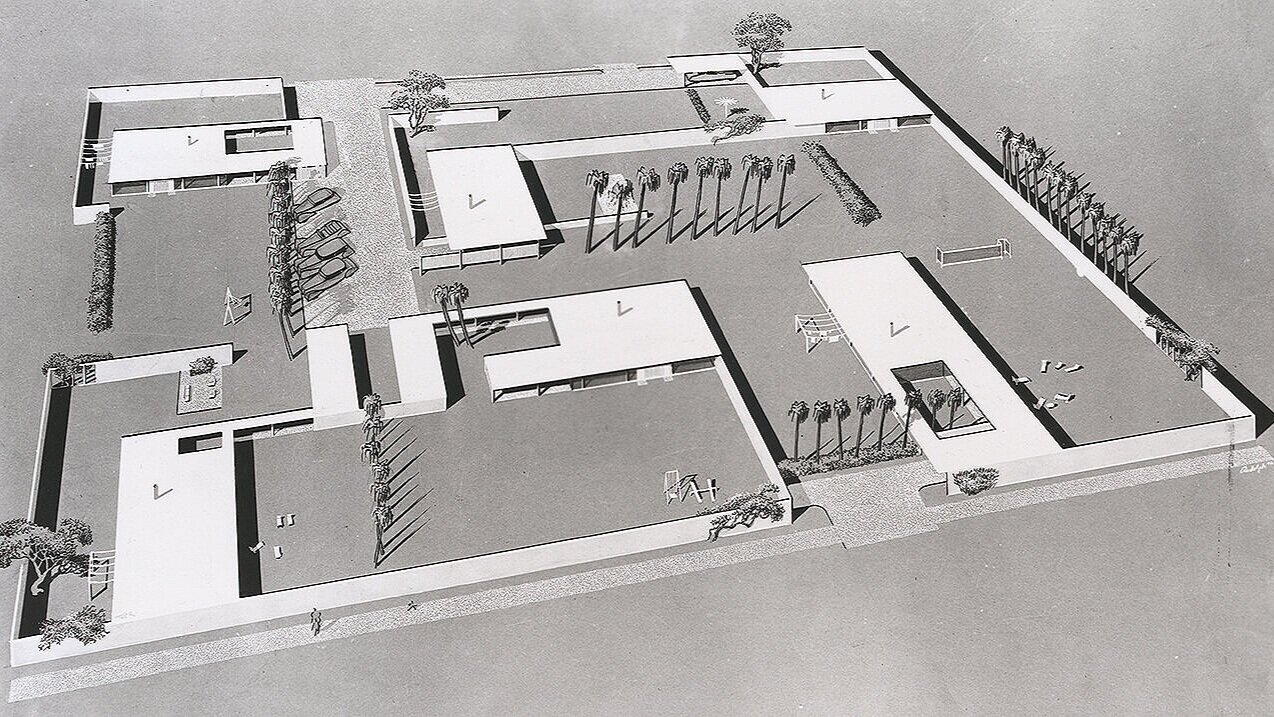
To this alliance, Twitchell is seen as having contributed an established position in the Sarasota community, a track record of successful projects, a way with clients, and a firm knowledge of construction—and Rudolph was the ultra-talented (and hardworking and prolific) youthful design genius. A productive period ensued, with many houses built and proposed—some of them among Paul Rudolph’s most striking designs, including: the widely-published Healy (“Cocoon”) House; the innovative Knott Residence; and the proposal for a complex of houses for the Revere Development (which showed Rudolph working skillfully within the vocabulary of Mies van der Rohe's “courtyard house” design experiments).

The Knott Residence, proposed for Yankeetown, Florida
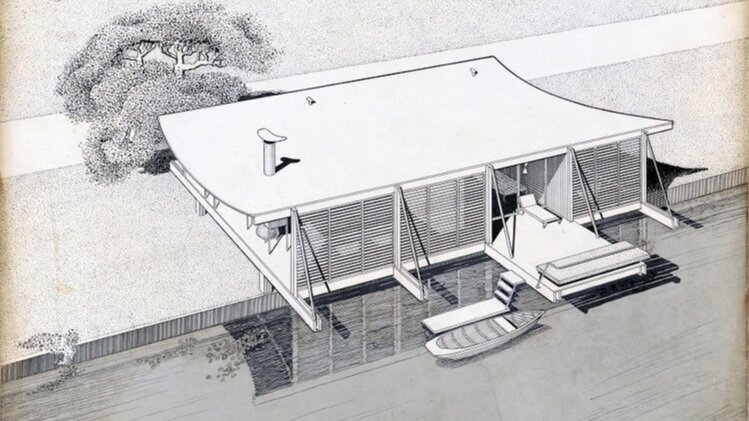
The Knott Residence, proposed for Yankeetown, Florida

The Healy (“Cocoon”) House, built in Sarasota, Florida
The Healy (“Cocoon”) House, built in Sarasota, Florida

The Revere Development,  proposed for Siesta Key, Florida

The Revere Development, proposed for Siesta Key, Florida

But, after about a half-decade of intense and successful work, Rudolph splits with Twitchell—apparently after a disagreement. Rudolph went on to found his own firm, attaining amazing success in the coming decades—both professionally and artistically.

ARCHETYPAL STORIES

So the impression one gets, from this highly condensed duo-biographical sketch, is that Twitchell provided the assets of the establishment: boring but practical and useful; whereas Rudolph injected the artistically energetic ingredients which really made their work interesting. Then, ultimately, it is the young genius who rebels and pursues his own path: an adventurous road to great achievement. From then on, we hear no more of Twitchell.

It is an appealing story, with its depiction of the talented and irrepressible “rebel”—and one wouldn’t have to search very hard into the work of Joseph Campbell to find, within the world of comparative mythology, that this is tale that can be found in all ages and cultures across the globe: the archetypal “Hero’s Journey”.

DEEPER AND BROADER

But, if there’s one thing that historians learn, it is that no story is simple—and, if one has the interest to dig, and to challenge the received wisdom, all stories keep opening up new questions and possibilities. The honest historian always wants—needs—to go deeper into the evidence, and look ever more broadly at what might have influenced/created a situation.

So let’s see if we can open-up (or as historians say, “unpack”) the above story. To do that, let’s consider the Twitchell Residence: how much is Twitchell and how much is Rudolph? We’ll probably never know the exact ratio and nature of their contributions to the design, but we can consider some of the factors that might have affected its planning and form. Items to consider include:

  • This is Twitchell’s personal home—and it is a natural feeling to be particularly focused on the design of one’s own home—and that’s especially true for architects! No matter how talented his young associate (Rudolph), is it plausible that a senior architect would hand-over the full responsibility for the architecture of his own home to someone else? Or is it more likely that he had important and key input into the design?

  • The building was completed in 1941. War is raging in Europe and Asia, and tremors of possible US involvement in the war—and a general national nervousness—are pervasive. Twitchell was old-enough to recall what happened during the previous World War: labor and materials had been in short-supply, and most construction was put on-hold for the duration of the fighting. Twitchell might have wanted to get his house built while it was still possible to do soand he’d have only one chance to get it right. So—for this one chance—would he completely abdicate design responsibly for that to another?

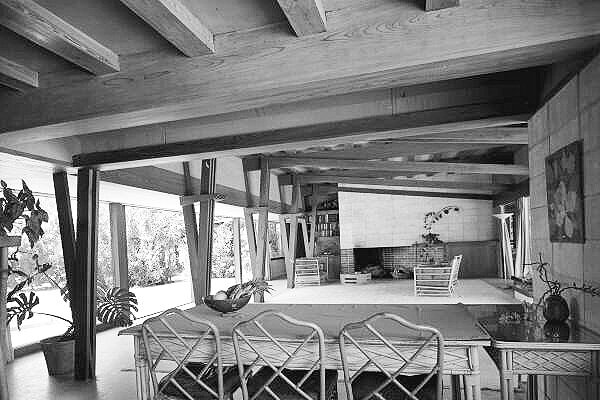
  • There are many striking similarities between the Living-Dining area of the Twitchell Residence, and the famous drafting room at Frank Lloyd Wright’s Taliesin West—too many to be just a coincidence [See comparison photos, below.]

  • There are other Wrightian aspects of the Twitchell House: the compactness of the bedrooms (Wright thought bedrooms should be small, almost cabin-like, and primarily for sleeping—and that residents would/should spend their time outside of them); Dining and Living Room Areas that merge into each-other; the primacy of a solid, prominent fireplace wall, as one of the defining elements of the Living Room; and the set of visually solid piers which define the parking area, which create a strong entry sequence to the house.

  • We know that Paul Rudolph was an ardent admirer of Wright—and that visiting a Wright home, at an early age, had been a decisive moment in Rudolph’s development. Rudolph’s devotion to Wright is something he’d acknowledge for his whole life. But—

The drafting room of Frank Lloyd Wright’s Taliesin West  —and iconic part of the Taliesin complex. Key features—the ones that create it’s overall character are: the open, uninterrupted space; the inclined ceiling; the expressed structure inclined beams across that ceiling: the directionality of the space, with one side opening to the exterior; the V-shaped, angled columns, at the open side of the room, which support the beams above.
The drafting room of Frank Lloyd Wright’s Taliesin West —and iconic part of the Taliesin complex. Key features—the ones that create it’s overall character are: the open, uninterrupted space; the inclined ceiling; the expressed structure inclined beams across that ceiling: the directionality of the space, with one side opening to the exterior; the V-shaped, angled columns, at the open side of the room, which support the beams above.

Both Twitchell and Paul Rudolph were aware of Wright’s work—and, from a young age, Rudolph was especially influenced by Wright’s designs (something he’d warmly acknowledge all his life). Above is the main living space of the Twitchell Residence: one is looking South into the Living Room, with the Dining area in the foreground. Was it Rudolph who urged that it follow so many of the features of Wright’s Taliesin drafting room?

Both Twitchell and Paul Rudolph were aware of Wright’s work—and, from a young age, Rudolph was especially influenced by Wright’s designs (something he’d warmly acknowledge all his life). Above is the main living space of the Twitchell Residence: one is looking South into the Living Room, with the Dining area in the foreground. Was it Rudolph who urged that it follow so many of the features of Wright’s Taliesin drafting room?

  • But Twitchell could equally have been aware of Wright. Frank Lloyd Wright was a relentless self-promoter and had been widely published for decades—so it would be impossible for any architect, of Twitchell’s era and age, to be ignorant of Wright. Further, given Wright’s decades of fame, Twitchell’s awareness of Wright’s work would have started well before he met Paul Rudolph.

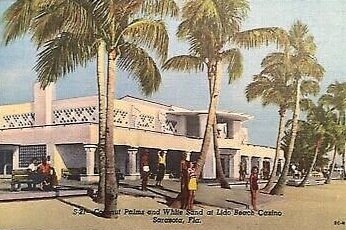
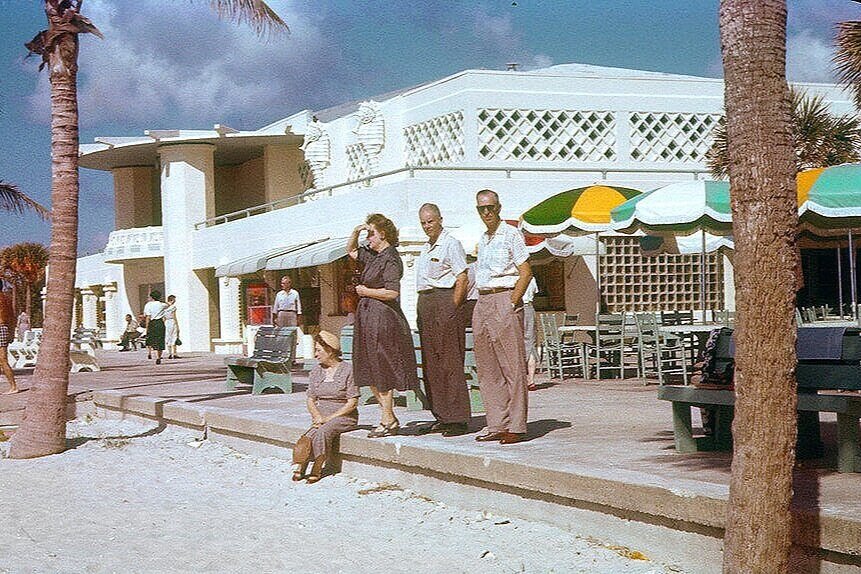
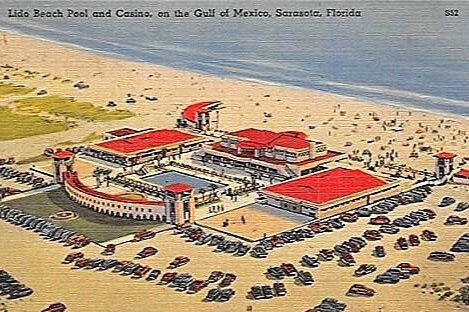
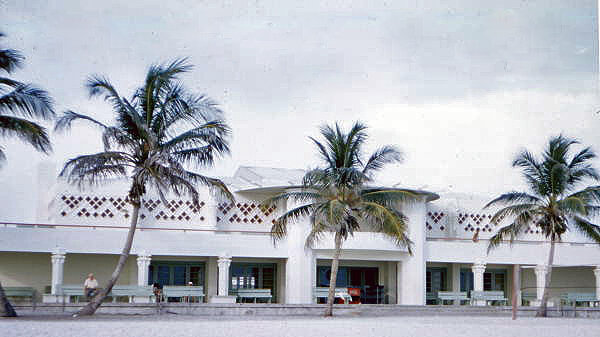
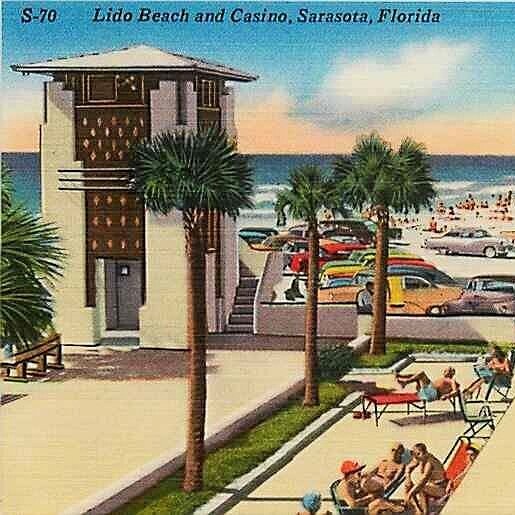
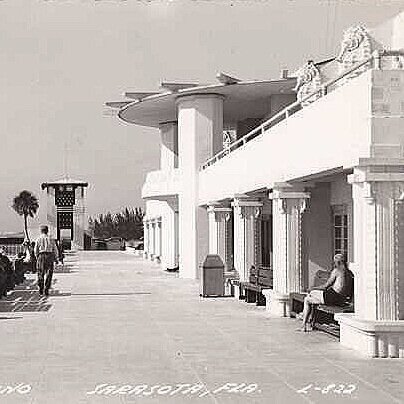
  • But, beyond familiarity, there’s a strong affinity between Wright’s work and another Twitchell project: one of his largest works, the Lido Beach Casino in Sarasota. The complex—an extensive structure with multiple parts and functions—was built in 1940, and probably planned in the previous year(s)—well before Rudolph was engaged by Twitchell. It was a venue for beach and pool swimming, dining, dancing, a nightclub, and shopping—and events of all kinds (beauty contests, swim meets, school and social) were held there.

  • The project bears a striking similarity to Wright’s Midway Gardens: excluding swimming, both the Lido Beach Casino and Midway are of similar scale, encompass nearly matching programs, and were aimed at the same type of audience.
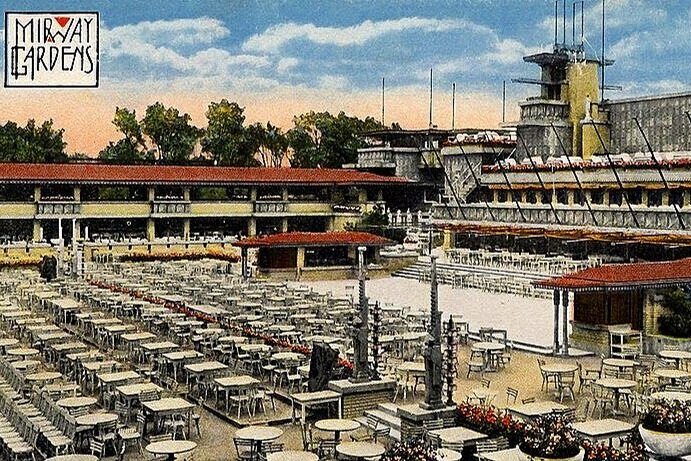
Frank Lloyd Wright’s Midway Gardens in Chicago
Frank Lloyd Wright’s Midway Gardens in Chicago

Ralph Twitchell’s Lido Beach Casino in Sarasota

Ralph Twitchell’s Lido Beach Casino in Sarasota

  • The two entertainment complexes share a “parti" (their basic architectural organization): both having a large, central, open space—which is enclosed and defined by structures for various functions, and which is anchored at one side by a taller main building.
Beachside view of the Lido Beach Casino—a view from circa 1956—showing the main, central structure that visually anchored the complex.

Beachside view of the Lido Beach Casino—a view from circa 1956—showing the main, central structure that visually anchored the complex.

  • Other aspects of the building display possible Wrightian influences, such as—-

  • The pronounced horizontality of the composition—both overall, and in its elements: the low, hipped roofs of the two towers (and in the linear detail at their mid-areas), and the disc-shaped cantilevered roof at the center of the beach elevation

  • The detailing of the columns

  • The use of block—and prominently including a pattern of penetrations in the block masonry walls

  • The creation of deep colonnades—not only offering protection from the sun, but also creating dramatically shadowed areas

  • The almost Mayan “introverted” feel of the building—like Wright’s Hollyhock House, due to the solidity of the massing and of individual elements like the columns

  • The display/celebration of structure—as in the rafters over the beachside elevation’s central roof, the hefty piers supporting that roof, and the line of columns

  • Altogether, one cannot ignore the possible Wright influences in this Twitchell-before-Rudolph project.

  • So the question becomes: If we see Wrightian influences here, could Twitchell also have brought such design input into his work with Rudolph?
postcard with tower.jpg
postcard%2Bwith%2Bcolumns.jpg
Sarasota-FL-Palms-White-Sands-Lido-Beach.jpg
lido another view.jpg

WITHER RALPH TWITCHELL?

In the standard history of their Twitchell and Rudolph’s partnership, Twitchell is known as the “business partner” -or- the “public face” (who charmed clients) -or- “the [construction] site guy”. But though he was all those things (and, apparently, excelled in those roles), perhaps he was more than that. He had an extensive career both before and after his partnership with Rudolph, and—as looked-at in the above two cases (his 1941 Residence, and the Lido Beach Casino) there are reasons to contend that he might have had more of a design talent and sensibility than he’s usually given credit for. The import of this is: his input into projects in the Twitchell and Rudolph partnership might possibly have been stronger than previously assumed.

THE HISTORIAN’S PERSPECTIVE

To be fair to both sides, we should mention that we do have Paul Rudolph’s counter-testimony to such an idea (Rudolph said that whatever was good and interesting in their work was attributed to himself alone!). We don’t mean to assail the integrity of Rudolph’s claim—but part of the work of history is to question such self-contained, categorical statements. “Meta-narratives”—the big, central stories by which we’ve long understood the course of events (at world, local, and personal scales)—are never quite inclusive-enough of all the facts: there always dissonant evidence (“out-of-place artifacts”), clues, even “hints” that stubbornly won’t go away, and a real historian will never ignore them. So the question of Twitchell’s ability and input as a designer is an open one.

CELEBRATING TWITCHELL

So today,. on his birthday, we give Twitchell some renewed attention and consideration—”giving him a little love” that he’s rarely received in the soundbite assessment that he often gets.

A talented, energetic, and enterprising figure—and one who may have had more focus on design than usually acknowledged—it is worth celebrating this important architect: RALPH SPENCER TWITCHELL

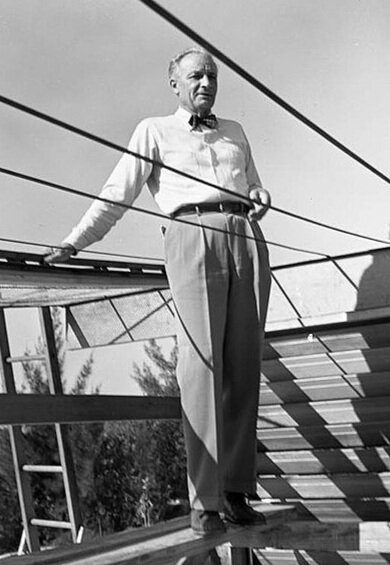
Ralph Twitchell (center) consulting with builders on-site. What’s intriguing about this image is that it shows the Healy (“Cocoon”) House under construction—and one can see the catenary metal straps, upon which house’s curved roof (its most pronounced feature) was to be suspended. Healy was the most famous building completed during Twitchell and Rudolph’s partnership, but after Rudolph departed, Twitchell continued to practice until at least the mid-1960’s, and lived until 1978—long enough to see his former partner, Rudolph, achieve stratospheric success and fame. One wonders what Twitchell thought of that: was he jealous, bitter, tranquil—or glad that he’d fostered such a profound and prodigious talent as Paul Rudolph?

Ralph Twitchell (center) consulting with builders on-site. What’s intriguing about this image is that it shows the Healy (“Cocoon”) House under construction—and one can see the catenary metal straps, upon which house’s curved roof (its most pronounced feature) was to be suspended. Healy was the most famous building completed during Twitchell and Rudolph’s partnership, but after Rudolph departed, Twitchell continued to practice until at least the mid-1960’s, and lived until 1978—long enough to see his former partner, Rudolph, achieve stratospheric success and fame. One wonders what Twitchell thought of that: was he jealous, bitter, tranquil—or glad that he’d fostered such a profound and prodigious talent as Paul Rudolph?


IMAGE CREDITS

NOTES:

The Paul Rudolph Heritage Foundation gratefully thanks all the individuals and organizations whose images are used in this non-profit scholarly and educational project.

The credits are shown when known to us, and are to the best of our knowledge, but the origin and connected rights of many images (especially vintage photos and other vintage materials) are often difficult determine. In all cases the materials are used in-good faith, and in fair use, in our non-profit, scholarly, and educational efforts. If any use, credits, or rights need to be amended or changed, please let us know.

When/If Wikimedia Commons links are provided, they are linked to the information page for that particular image. Information about the rights for the use of each of those images, as well as technical information on the images, can be found on those individual pages.

CREDITS, FROM TOP-TO-BOTTOM and LEFT-TO-RIGHT:

Floor plan of the Twitchell Residence: © The Estate of Paul Rudolph, The Paul Rudolph Heritage Foundation; Photo portrait of Ralph Twitchell: by Joseph Steinmetz, from the State Library & Archives of Florida, via Wikimedia Commons; Perspective renderings by Paul Rudolph of the Knott Residence, Healy (“Cocoon”) House, and the Revere Development: © The Estate of Paul Rudolph, The Paul Rudolph Heritage Foundation; Taliesin West drafting room: photo by Steven C. Price, via Wikimedia Commons [Note: to help facilitate comparisons between this space and the Twitchell Residence Living Room (the next picture), this photo of the drafting room has been flipped, and color was removed.]; Ralph Twitchell Residence Living Room: by Joseph Steinmetz, from the State Library & Archives of Florida; Midway Gardens: vintage post card. circa 1915, via Wikimedia Commons; Beachside view of Lido Beach Casino, circa 1956: photo, circa 1956, via Wikimedia Commons; Post cards and photos of Lido Beach Casino: vintage images; Photo portrait of Ralph Twitchell at Healy construction site: by Joseph Steinmetz, from the State Library & Archives of Florida, via Wikimedia Commons

Celebrating EZRA STOLLER

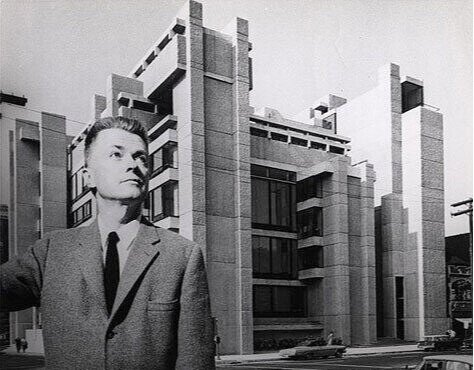
The famous architectural photographer (with his famous subject) himself gets photographed:  During the 1963 New Haven session, during which Ezra Stoller made his iconic photographs of Paul Rudolph and his Yale Art & Architecture Building, Judith York Newman captured the two of them in action.

The famous architectural photographer (with his famous subject) himself gets photographed: During the 1963 New Haven session, during which Ezra Stoller made his iconic photographs of Paul Rudolph and his Yale Art & Architecture Building, Judith York Newman captured the two of them in action.

We celebrate the 106th Birthday of EZRA STOLLER (May 15, 1915 – October 29, 2004) — one of America’s greatest architectural photographers.

Anybody who has tried to capture a good image of a building (or architectural interior or detail) will know that there is no such thing as a purely objective photograph. Instead: the photographer makes significant decisions about composition, lighting, depth-of-focus, proportion, distance, contrast, framing, and other factors. Both the architect and the photographer have to deal with practical requirements but, no less than with the architect, the result of the photographer’s efforts is an artistic work: one which can be both expressive and meaningful.

What photographer operated at the highest level of this simultaneously practical and artistic discipline? When one thinks of architectural photography in America, the name—or rather: the images—of Ezra Stoller are what probably first come-to-mind. For decades, Stoller photographed many of the 20th Century’s most significant new buildings in the US and thereby created an extensive archive of the achievements of Modern American architecture. More than that, Stoller’s views are some of the most iconic images of that era of design, or of particular buildings.

EZRA STOLLER AND PAUL RUDOLPH:

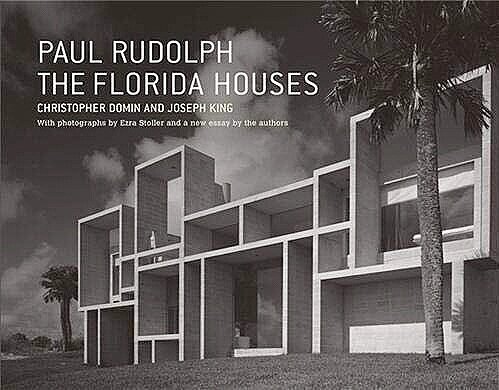
better florida book cover.jpg

Of the several photographers that Rudolph worked with, Ezra Stoller is likely the one with which he had the most involvement and lasting relationship. Stoller photographed much of his residential work in Florida—including some of Rudolph’s greatest and most innovative houses like the Milam Residence (as seen on the cover of Domin and King’s book on the Florida phase of Rudolph’s career (see image at right), the Walker Guest House, the Umbrella House, and the Healy “Cocoon” House. He also captured the Yale Art & Architecture Building (see below), Sarasota Senior High School, the Temple Street Parking Garage, Endo Labs, the UMass Dartmouth campus, the Tuskegee Chapel, the Hirsch (later: “Halston”) Townhouse in New York City , the Wallace House, Riverview High School , the Sanderling Beach Club, and numerous others—including the Burroughs Wellcome US headquarters and research center.

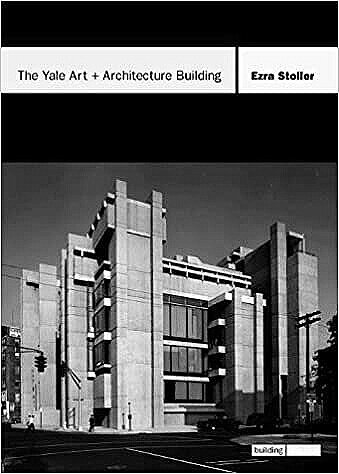
Ezra Stoller took a series of photographs of Paul Rudolph’s Yale Art & Architecture Building (now rededicated as Rudolph Hall)—including the above portrait of Rudolph with the building in the background. Decades later, Stoller issued a set of monographs on key works of Modern architecture—his “Building Blocks” series—and the Yale  building was selected to be one of the structures upon which the books focused (see image at right.) One of Stoller’s photos of the building—taken when it was freshly finished, in 1963—was to become an iconic image, and was used on the cover of the book.

Ezra Stoller took a series of photographs of Paul Rudolph’s Yale Art & Architecture Building (now rededicated as Rudolph Hall)—including the above portrait of Rudolph with the building in the background. Decades later, Stoller issued a set of monographs on key works of Modern architecture—his “Building Blocks” series—and the Yale building was selected to be one of the structures upon which the books focused (see image at right.) One of Stoller’s photos of the building—taken when it was freshly finished, in 1963—was to become an iconic image, and was used on the cover of the book.

Stoller yale book.jpg

STOLLER: ON-EXHIBIT, IN-PRINT, AND ON-VIEW

EXHIBITIONS:

Ezra Stoller’s work was exhibited numerous times: we know of at least ten solo exhibitions (listed here)—and the countless times when his photographs were included as parts of other exhibits, around-the-world (including in major museums).

BOOKS:

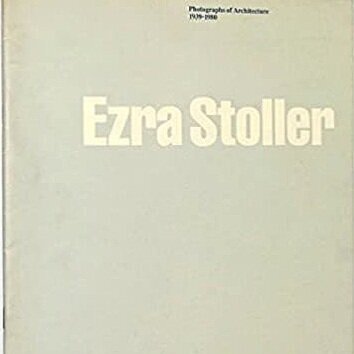
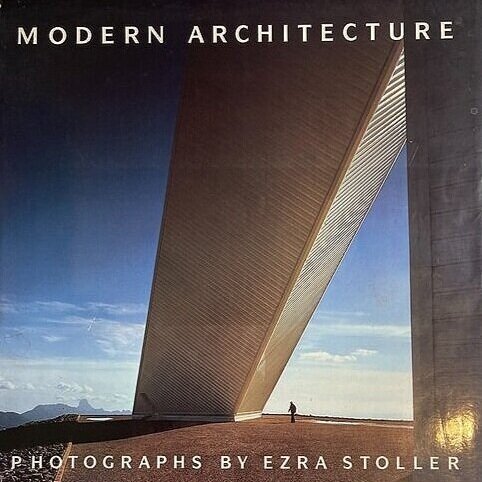
His photographs are in magazines and journals, as well as books that cover architecture (and, significantly, they’re in the monographs of individual architects—including Paul Rudolph). Several books have been published which focus exclusively on Ezra Stoller’s work, from “Ezra Stoller: Photographs of Architecture” (1980) -to- “Modern Architecture: Photographs by Ezra Stoller” (1999). The latter’s cover features a stark photograph in color—and that illustrates an important point: although Stoller is most well-known for his work in black & white photography, he could also create striking images in full color.

early stoller architecture book.jpg
modern book by stoller.jpg

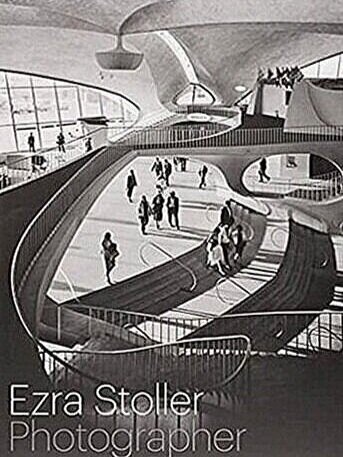
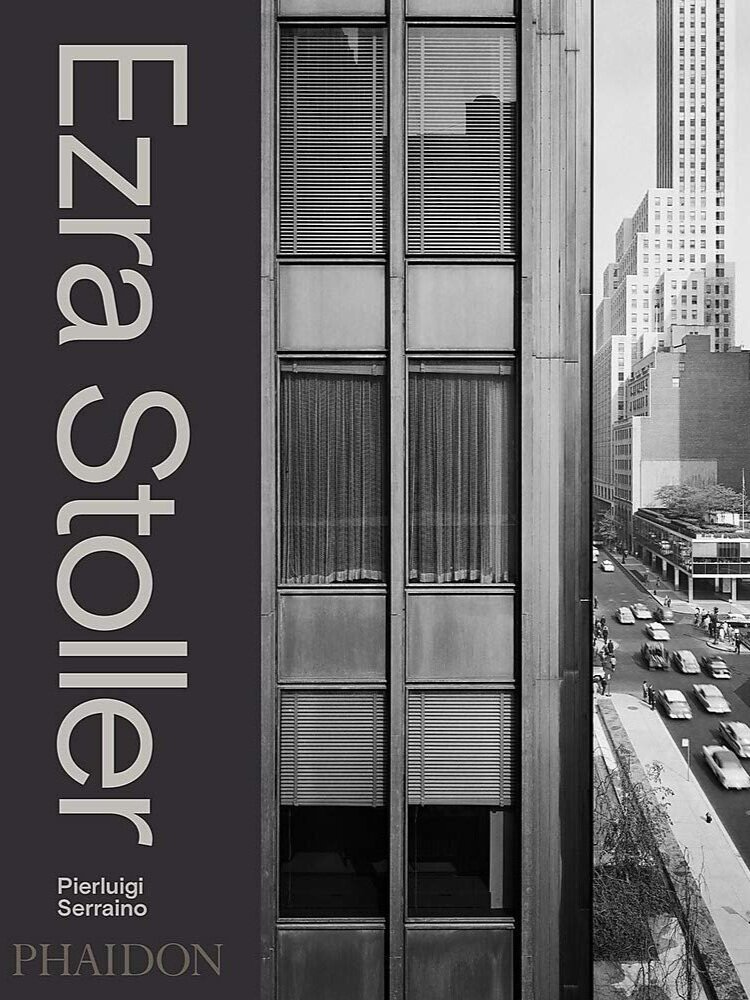
More recently, his work has been collected into extensive, large-format monographs—which allow one to comprehend and appreciate his full career: “Ezra Stoller, Photographer” (2012); and “Ezra Stoller: A Photographic History of Modern American Architecture” (2019). At 288 and 416 pages, respectively, these two volumes offer comprehensive views of Stoller’s oeuvre—and of the Modern era, subjects, and architects upon which he was focused.

stoller book cover.jpg
stoller new book cover.jpg

EZRA STOLLER — TODAY:

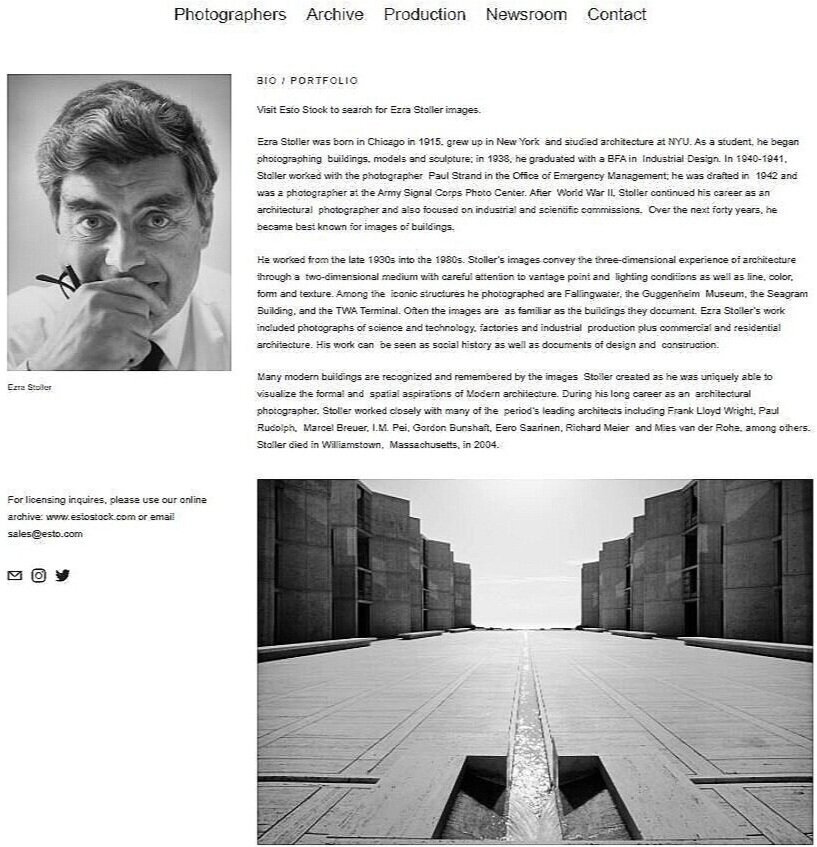
A screen capture from the ESTO website, of the page focusing on Ezra Stoller. It includes a portrait of the famous photographer himself, as one of his iconic images of a building by Louis Kahn: the Salk Institute.

A screen capture from the ESTO website, of the page focusing on Ezra Stoller. It includes a portrait of the famous photographer himself, as one of his iconic images of a building by Louis Kahn: the Salk Institute.

ESTO, the organization founded by Ezra Stoller, continues to operate, and is now directed by his daughter, Erica Stoller. It provides access to their extensive photographic archive: a treasury of images of unique importance to the history and understanding of Modern architecture, and which documents the work of key architects of the 20th Century.

Within that archive are images of compelling photographic power. One can see its holdings via the Esto Stock collection here—and an indication of the depth its holdings can be judged by the fact that it includes nearly 800 photographs of Paul Rudolph’s work; as well as the work of Wright, Saarinen, SOM, Breuer, Meier, Kahn, Aalto, Johnson, Warnecke, Mies, and numerous others.

ESTO also continues to be the home of a group of professional. design-focused photographers who work in Stoller’s tradition of clarity, expressive imagery, and compelling vision—whether capturing a building complex, a set of interiors, or singular objects. At their website, one can can see these photographers’ portfolios.


IMAGE CREDITS

NOTES:

The Paul Rudolph Heritage Foundation gratefully thanks all the individuals and organizations whose images are used in this non-profit scholarly and educational project.

The credits are shown when known to us, and are to the best of our knowledge, but the origin and connected rights of many images (especially vintage photos and other vintage materials) are often difficult determine. In all cases the materials are used in-good faith, and in fair use, in our non-profit, scholarly, and educational efforts. If any use, credits, or rights need to be amended or changed, please let us know.

When/If Wikimedia Commons links are provided, they are linked to the information page for that particular image. Information about the rights for the use of each of those images, as well as technical information on the images, can be found on those individual pages.

CREDITS, FROM TOP-TO-BOTTOM, AND LEFT-TO-RIGHT:

Ezra Stoller photographing Paul Rudolph: photo by Judith York Newman, © The Estate of Paul Rudolph, The Paul Rudolph Heritage Foundation; Cover of “Paul Rudolph: The Florida Houses”: from the Amazon page for that book; Photo portrait of Paul Rudolph, with the Yale Art & Architecture Building in the background: photograph by Ezra Stoller;  Cover of “The Yale Art + Architecture Building”: from the Amazon page for that book;  Cover of “Ezra Stoller: Photographs of Architecture”: from the Amazon page for that book;  Cover of “Modern Architecture: Photographs by Ezra Stoller”: from the Amazon page for that book;  Cover of “Ezra Stoller, Photographer”: from the Amazon page for that book;  Cover of “Ezra Stoller: A Photographic History of Modern American Architecture”: from the Amazon page for that book;  Esto page with Stoller portrait and Salk photo: screen capture from Esto website

You call that "Preservation" ? — UPDATE on the plight of the Biggs Residence

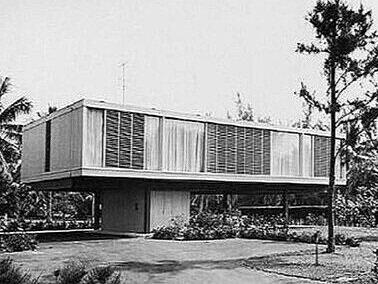
Paul Rudolph’s Biggs Residence in Delray Beach, Florida. Here it is shown in a 1956 photograph, in a prime, just-completed condition, as Rudolph had conceived it. But decades of changes by subsequent owners marred Rudolph’s design—and those included…

Paul Rudolph’s Biggs Residence in Delray Beach, Florida. Here it is shown in a 1956 photograph, in a prime, just-completed condition, as Rudolph had conceived it. But decades of changes by subsequent owners marred Rudolph’s design—and those included insensitively installed air conditioning equipment, and visually obtrusive additions. The intention: New owners and their architect declared that they wanted to “Bring it back to the way it should look..” and “Bring it back to the original layout and then assess what their next step will be.”

And what happened: Applying for a Certificate Of Appropriateness, they said: “The addition does not change or effect any of the distinctive features, finishes or construction techniques of the historic house. The house is being preserved and restore…

And what happened: Applying for a Certificate Of Appropriateness, they said: “The addition does not change or effect any of the distinctive features, finishes or construction techniques of the historic house. The house is being preserved and restored as originally designed by Paul Rudolph without any compromise arising out of the addition proposal, except for the connector at the rear, least public view.” In a report, commissioned by Delray Beach, the city’s consulting architect says: “In my professional opinion this is a false statement.”

“The demolition of this unique site has far reaching consequences for the legacy of Paul Rudolph, the Sarasota School of Architecture, the much-prized historical character of the city, and the neighbors who now have to contend with prolonged construction.”

—Official statement by the city of Delray Beach

THE BIGGS RESIDENCE: ITS IMPORTANCE—AND THE PROPER PROCESS FOR CHANGE

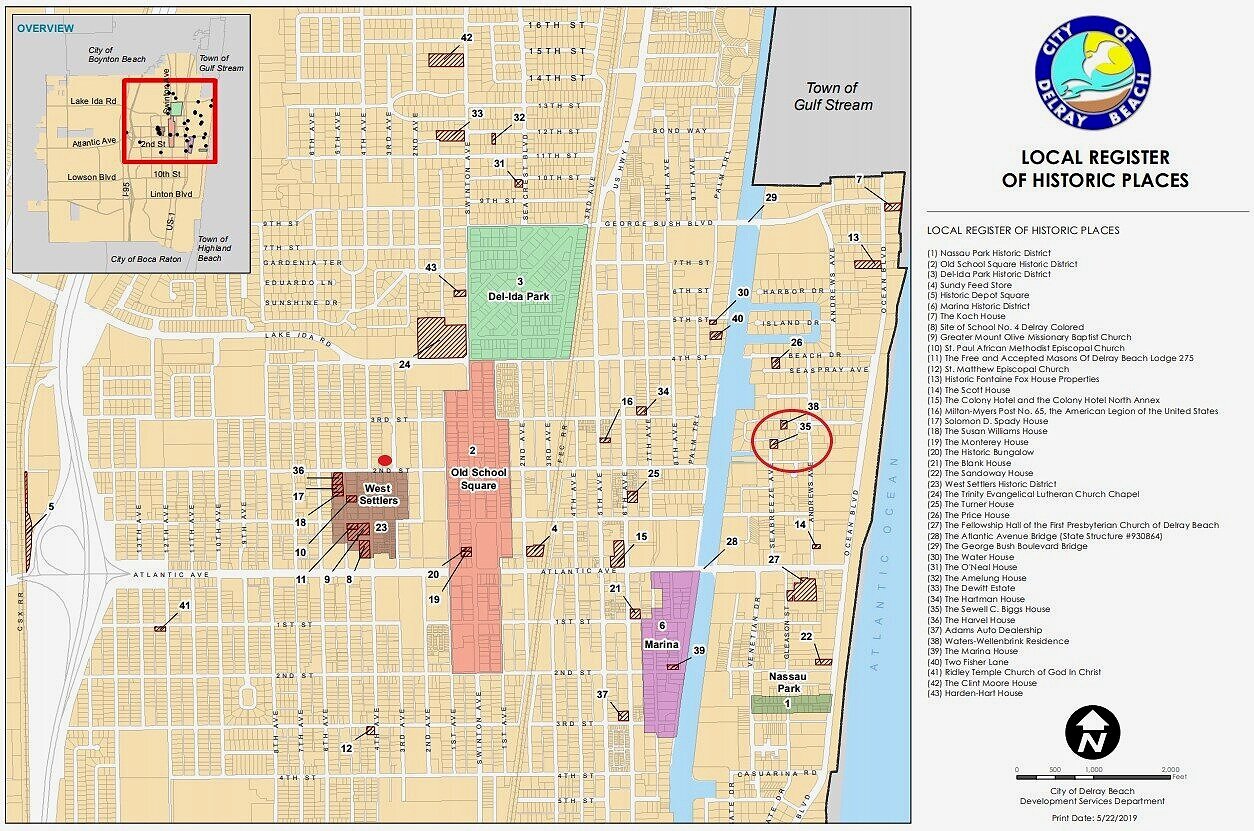
The city of Delray Beach’s map showing the buildings on their Local Register of Historic Places. The Biggs Residence (number 35) is within the red oval near the map’s right-hand edge. A larger version of the map is here.

The city of Delray Beach’s map showing the buildings on their Local Register of Historic Places. The Biggs Residence (number 35) is within the red oval near the map’s right-hand edge. A larger version of the map is here.

The Biggs Residence—a Paul Rudolph design of 1955—is an important part of his oeuvre. It is also a prime example of Florida’s Mid-Century Modern architecture, by that era’s (and region’s) leader of Modern American design.

The Biggs Residence has been recognized as a significant part of Florida’s cultural heritage: in 2005 the city of Delray Beach’s Historic Preservation Board recommended that it be added to the city’s Local Register of Historic Places—and that was approved by the City Commission.

Any proposed changes to a building on that Register must be fully reviewed by the city’s preservation officer and and the historic preservation board. If approved by them, the project will receive a “Certificate of Appropriateness” (COA).

BIGGS: CHANGES AND CONTINUITIES

The Biggs Residence in 20i6, showing an accumulation of changes and/or additions.

The Biggs Residence in 20i6, showing an accumulation of changes and/or additions.

Over the decades, subsequent owners to the Biggs Residence have not completely held to Rudolph’s original design. Additions and changes have departed from the building as Paul Rudolph conceived it—and the results have often been visually obtrusive. And, of course, any distinguished building that’s reaches a half-century of age will be in need of multiple kinds of care—just like a classic car—and how each owner handles that care & repair will vary with their knowledge, sensitivity, and means. Consequently, their effects on the building will range in quality—and sometimes the accumulated impacts will be profoundly contrary to the spirit of the original design.

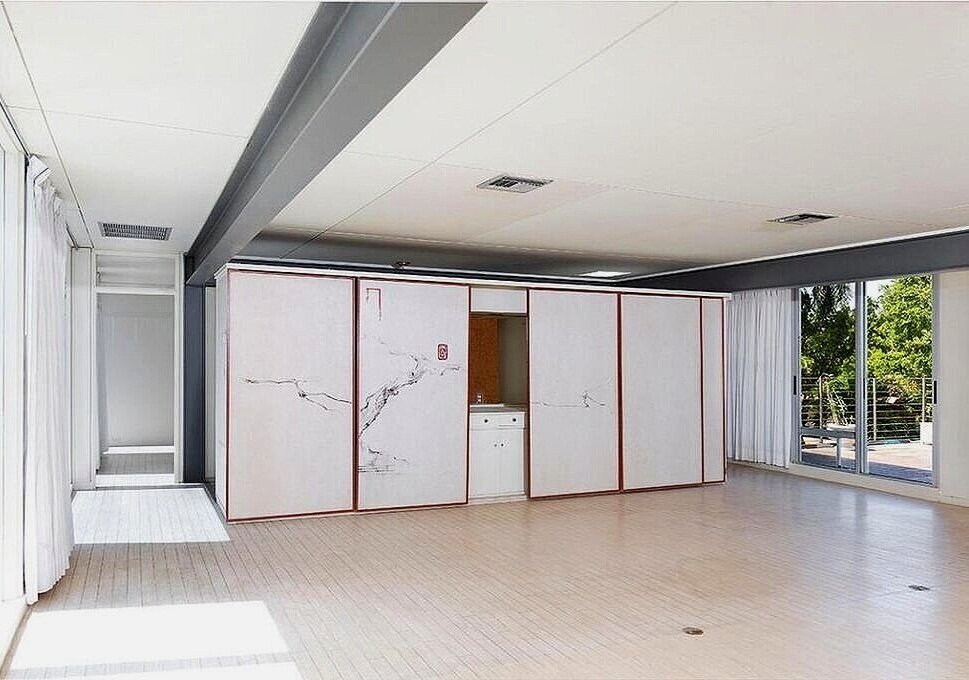
Yet the main part of what Rudolph created at Biggs remained—the essential raised volume of living spaces. Also, as shown in the two comparison photos below, significant aspects of its original internal character had been maintained—and that’s to be valued and praised.

Dining%25252BRoom%25252Bwith%25252BStorage%25252BWall%25252B--%25252BBiggs.jpg
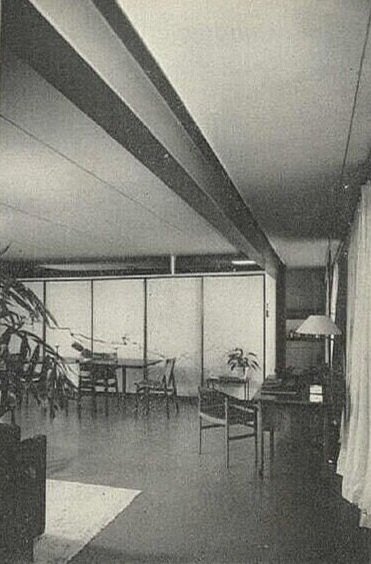
LEFT:  An interior view of the Biggs Residence in 1959—showing the house in its original state, as designed by Paul Rudolph.  This view of the central living-dining area is towards the dining table at the end of the room, which sits near the storage…

LEFT: An interior view of the Biggs Residence in 1959—showing the house in its original state, as designed by Paul Rudolph. This view of the central living-dining area is towards the dining table at the end of the room, which sits near the storage wall. At the far right is the entry passage to the kitchen. In this photograph, one of room’s pair of large and prominent steel ceiling beams is clearly seen

ABOVE: As of 2016, when this photograph was taken, the house’s main living space still retained its essential character of a spacious openness in its center, as well as other Rudolph-designed features: the emphatically displayed steel structure, and the wall of storage (behind moving panels) at one end of the room

CHANGES: The POSTIVE INTENTIONS

New owners acquired the Biggs Residence in 2018, and wished to make changes. That’s not unusual, nor is it to be disparaged: as lifestyles evolve, expectations for our residences change too—so even important and classic works of architecture sometimes undergo alteration, and this happens most often after they change ownership. But when someone buys a distinguished work-of-architecture, it is hoped that they will be sympathetic to the original architect’s conception, and any changes will be discrete and respectful—and, as noted in our last article, there’s a serious body of helpful preservation knowledge about how to proceed in such cases (and a whole profession standing ready to assist in these projects.)

In 2018 the owners visited the Paul Rudolph Heritage Foundation at our NYC headquarters in the Paul Rudolph Modulightor Building. They told us about their plans to remove the two additions (and add a discrete new one) that would allow the original home to look as close to Rudolph’s original design in almost 37 years. They also gave us copies of drawings and research they had collected as well as shared drawings and renderings of the final design with us. We were pleased with their proposal and considered this project to be in the “safe” category. We didn’t think anything of it at the time, but this would be the last communication we had with them.

As per proper procedure, the proposed alterations to the Biggs Residence were submitted for review (and re-review with amendments). The owner’s (and their architect’s) stated goals were admirable—and their declared intentions for the proposed work included:

“Bring it back to the way it should look.”

“Bring it back to the original layout and then assess what their next step will be.”

“The addition does not change or effect any of the distinctive features, finishes or construction techniques of the historic house. The house is being preserved and restored as originally designed by Paul Rudolph without any compromise arising out of the addition proposal, except for the connector at the rear, least public view.”

CHANGES: The RESULTS

post+headline.jpg

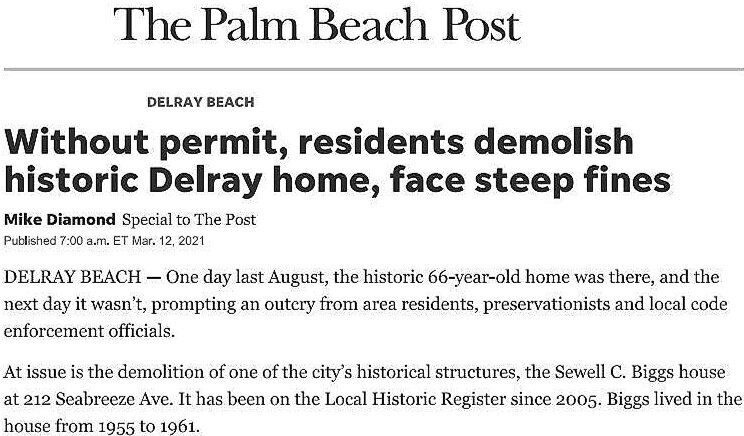
We don’t dispute the good intentions of the owners and their architects. We realize that there’s often another side (or sides) to any story, and we truly welcome further information, input, and other points-of-view. But we were distressed when a report came in that far more changes had happened on-site than had been approved—as when we saw the March 12th headline from the Palm Beach Post (see it, with the beginning of their story, at right), along with a photo like the one at the top of this article.

We weren’t the only ones to be alarmed. The city of Delray Beach was on-the-case, bringing the owners before a magistrate. As part of their investigation, the city commissioned an investigative report from an independent architect (more about that, later).

THE CITY OF DEL RAY ISSUED THE FOLLOWING STATEMENT:

Delray Beach values and protects its historic buildings. The city’s Historic Preservation staff work hand-in-hand with property owners, architects, and builders to guide them through the approval process and serve as a resource when restoring or renovating historic buildings and sites.  

The site at 212 Seabreeze Avenue, known as the Sewell C. Biggs House, was designed in 1955 by internationally renowned architect Paul Rudolph, who was part of the Sarasota School of Architecture and later Chairman of the School of Architecture at Yale University. The Sewell C. Biggs House is a historic structure listed on the Delray Beach Local Register of Historic Places. 

During August 2020, the Sewell C. Biggs House was demolished down to its metal frame. This action was not approved by the city and is a stark contrast to the original plan presented to and approved by the city’s Historic Preservation Board, which emphasized a desire to respectfully rehabilitate and restore Paul Rudolph’s original building with minimal changes. 

The decision not to inform the city effectively denied staff the ability to determine if the demolition was warranted, and the opportunity to inspect the site to assess how much of the original, historically significant, structure could have been saved. 

The demolition of this unique site has far reaching consequences for the legacy of Paul Rudolph, the Sarasota School of Architecture, the much-prized historical character of the city, and the neighbors who now have to contend with prolonged construction. 

Moving forward, the city’s goal is to work with the owners and the Historic Preservation Board to bring this historically significant building back to a state of historical integrity, as much as may be possible. The city has hired an architect with expertise in historic buildings to provide guidance to staff and help establish a path forward for the owners.

THE INVESTIGATION REPORT

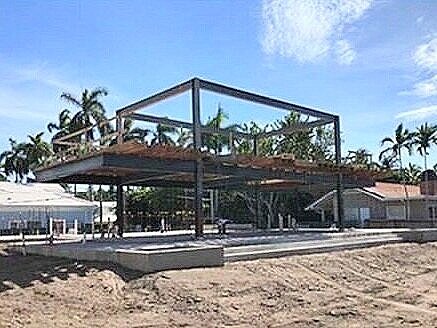
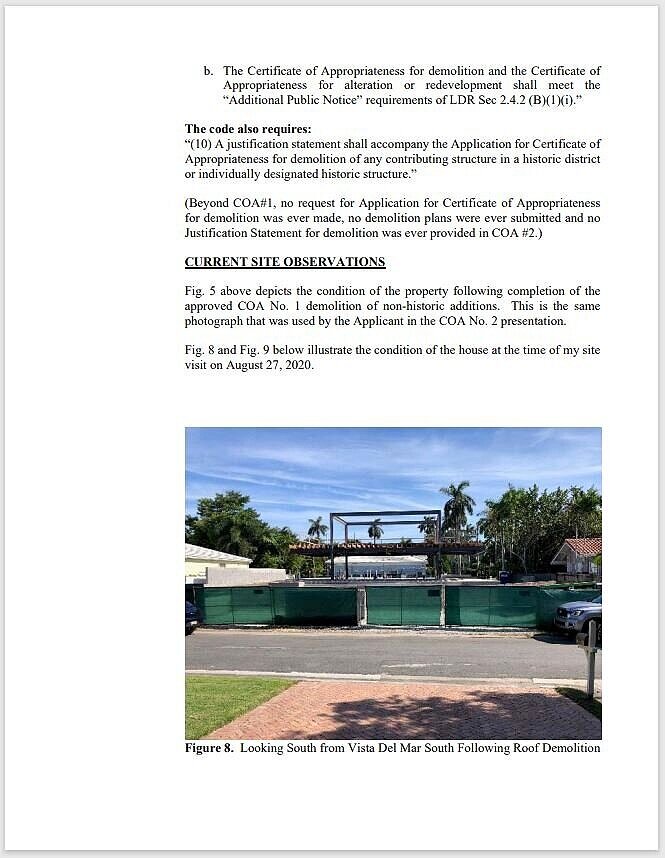
A page from the report. It includes a photo, taken at the construction site in 2020, showing the remaining steel after the house’s roof and walls had been demolished.

A page from the report. It includes a photo, taken at the construction site in 2020, showing the remaining steel after the house’s roof and walls had been demolished.

When Delray’s Principal Planner in their Historic Preservation department sent us the above statement, they also sent along.

“. . . .the consultant report we received from Mr. Richard Heisenbottle, the architect the city hired to review the project following the demolition.”

Richard Heisenbottle’s report traces the history of the project, including: proposals and the documents submitted for review, testimony made before the Historic Preservation Board, revisions offered and reviewed, decisions made—and what he observed during a site visit.

The report compares what he owners and/or their architects stated, and what Mr. Heisenbottle assesses as to what really is the case—and some of the contrasts are stark (and you can read the full report here.)

Below are a few excerpts. First, the report’s author quotes from a promise or assertion made by the owners or their architect—and then (in parenthesis) is his assessment of the actuality of the situation.

  • “The proposed work does not involve any removal of any characteristic features of the original house, such as the previously proposed plan to remove the 2nd floor and the galley kitchen, both of which will stay intact.” (This is an incorrect statement or a statement that has been violated. The work performed most definitely involved removal of characteristic features. The entirety of the perimeter walls, siding and roof framing have been removed. The galley kitchen has also been removed.)

  • Distinctive features, finishes, and construction techniques or examples of craftsmanship that characterize a property shall be preserved. “The characteristic elevated steel columns and steel beam structure will be structurally rehabilitated, but otherwise preserved as is with respect to its original design. (The steel column and beam structure are the only element of the original structure being preserved. All else, wall framing, roof framing, windows, doors and siding are all being replaced and replicated.)

  • The proposed work does not add new features or elements from other buildings. (The Applicant’s plan does add new features.)

  • “Deteriorated historic features shall be repaired rather than replaced. Where the severity of deterioration requires replacement of a distinctive feature, the new feature shall match the old in design, color, texture and other visual qualities and, where possible materials.” The existing steel structure will be repaired and rehabilitated not replaced. The characteristic features of the historic house such as the grooved wood siding, will be restored and replaced, and if damaged beyond restoration, will be replaced with matching materials.” (None of the grooved wood siding or exterior wall studs were saved or restored, everything was replaced without providing any notification to HPB of the need for or extent demolition.)

The report offers several conclusions, some key ones being:

  • Upon review and evaluation of all materials submitted to the City by the Owner in support of their Certificate of Appropriateness Application No. 2 and Building Permit Application, and as a result of my on-site inspection of the property to access its current condition, I have concluded that the owner and his general contractor have gone well beyond what was authorized in the COA and what was authorized on the approved Building Department Permit Plans.

  • The extent of demolition could not have been anticipated under the approved COA submittal documents or under the proposed Construction Documents.

  • In addition to non-compliance with the LDR requirements for demolition of more than 25% of a historic structure, the owner raised the structure in violation of the approved COA and without advising and receiving permission to do so from the Building Department and the HPB.

He then looks at the option for reconstructing the building. “Reconstruction” has a specific and rigorous meaning and set of standards, as defined by the U.S. Department of the Interior’s “Secretary of the Interior’s Standards for Reconstruction and Guidelines for Reconstructing Historic Buildings” (and you can read more about them here.) The report’s author reviews the standards, in preparation for his final recommendation—one which we feel needs to be contested.

AUTHENTICITY?

While we applaud the thoroughness of the report, we dispute one of its conclusions—the one wherein its author says that a—

“. . . .properly executed rehabilitation and partial reconstruction can continue to be listed as a historic resource on the Delray Beach Local Register of Historic Places.”

Our experience, and supported by a professional preservation expert we reached out to about this matter, is that no reconstruction of a building can authentically match the original. That’s because of the several real and intractable phenomena of the construction process:

  • No documentation is ever complete enough to convey all aspects of a building. Even the most through records will not include all of a building’s varying connections, adjacencies of materials, details, and the incorporation of various systems both material, structural and mechanical. [What architects term the “conditions”.]

  • Current building, life-safety, and energy codes; rules imposed by insurance companies; and desired upgrades due to higher quality-of-life expectations can be accommodated—but one can only make a best guess at what the original architect would have done had they been commissioned to deal with these latter-day challenges.

  • When one is trying to integrate such changed standards into a yet-to-be-built building (because the original had been demolished), there is no “push-back” from the material presence of an extant building—and hence nothing to discipline the new decisions.

  • Every building project—no matter how thoroughly thought-out in advance (and no matter how complete the drawings and specifications seem to be)—has gaps in its conception. Questions inevitably come-up during construction: issues whose decisions definitely will affect the look and quality of the outcome of the project. Ideally, the architect is consulted on each of these issues (either during site visits, or during frantic phone calls from the site)—and gives their solutions. Each architect will solve things in their own way, and Paul Rudolph was well known to be demanding during such site visits. How, during a “reconstruction” could his reactions to construction issues possibly be anticipated? They cant.

We acknowledge that a “reconstruction” might proceed in the most conscientious and well-intended way, carefully attempting to recreate the original Briggs Residence. But, for the above reasons, the Paul Rudolph Heritage Foundation will not support such a rebuilding as an authentic Rudolph design—and we will note that in our comprehensive list of the works of Paul Rudolph. The original residence will remain ‘demolished’ in our project list.

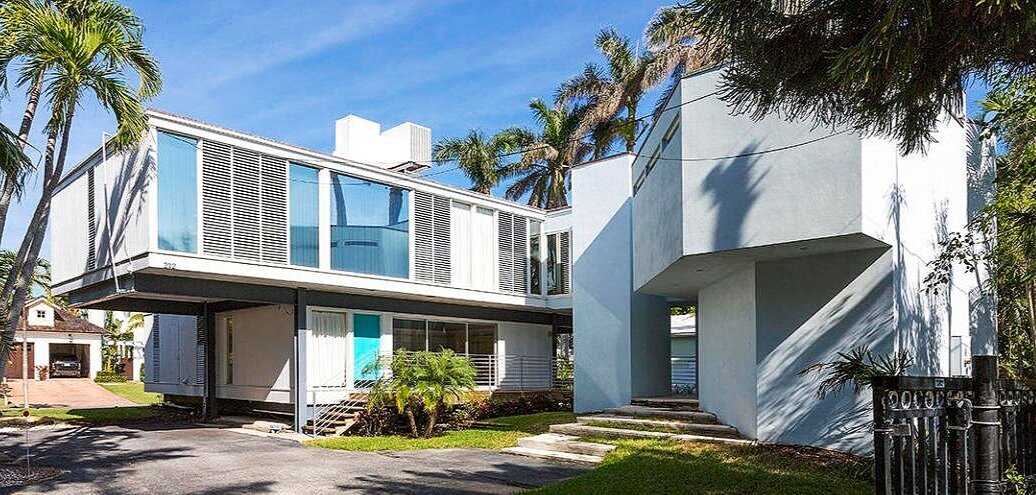
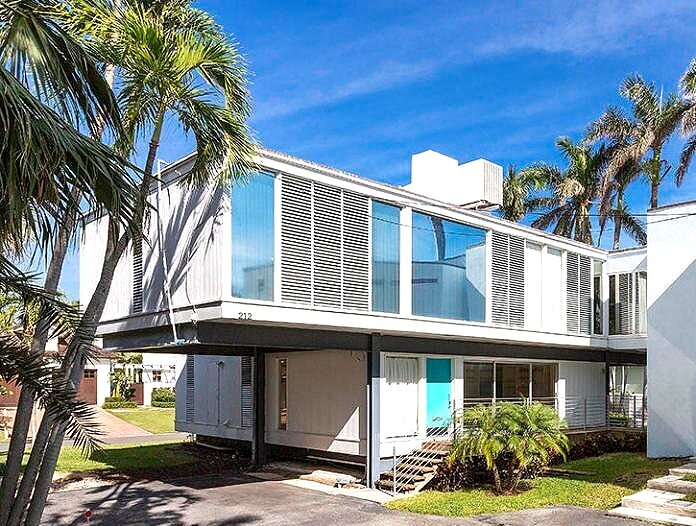
Even with all the changes and additions over the years, this photo shows that essential aspects of the Biggs Residence were still extant as of 2016—prior to the recent act of demolition.

Even with all the changes and additions over the years, this photo shows that essential aspects of the Biggs Residence were still extant as of 2016—prior to the recent act of demolition.


IMAGE CREDITS

NOTES:

The Paul Rudolph Heritage Foundation (a non-profit 501(c)3 organization) gratefully thanks all the individuals and organizations whose images are used in this non-profit scholarly and educational project.

The credits are shown when known to us, and are to the best of our knowledge, but the origin and connected rights of many images (especially vintage photos and other vintage materials) are often difficult determine. In all cases the materials are used in-good faith and in fair use in our non-profit scholarly and educational efforts. If any use, credits, or rights need to be amended or changed, please let us know.

When Wikimedia Commons links are provided, they are linked to the information page for that particular image. Information about the rights to use each of those images, as well as technical information on the images, can be found on those individual pages.

CREDITS, FROM TOP-TO-BOTTOM, AND LEFT-TO-RIGHT:

Biggs Residence in the 1950’s: photo as shown in the report, “Evaluation of COA Approval 212 Seabreeze Avenue, Delray Beach, FL 33483 RJHA Project No. 20-3494”, commissioned by the City of Delray Beach;  Biggs Residence condition after current demolition work: photo as shown in the report, “Evaluation of COA Approval 212 Seabreeze Avenue, Delray Beach, FL 33483 RJHA Project No. 20-3494”, commissioned by the City of Delray Beach;  Delray Beach Local Register of Historic Places: courtesy of City of Delray Beach;  Biggs Residence with additions in 2016: © Linda Lake / The Fite Group Luxury Homes;  Biggs Residence Living-Dining area in the 1950’s: photo by Ernest Graham, from a vintage issue of House & Home magazine, June 1959, courtesy of US Modernist Library;  Biggs Residence Living-Dining area as of 2016: © Linda Lake / The Fite Group Luxury Homes;  Biggs Residence as of 2016: © Linda Lake / The Fite Group Luxury Homes