paul rudolph

Celebrating Ralph Twitchell, Architect: With and Beyond Paul Rudolph

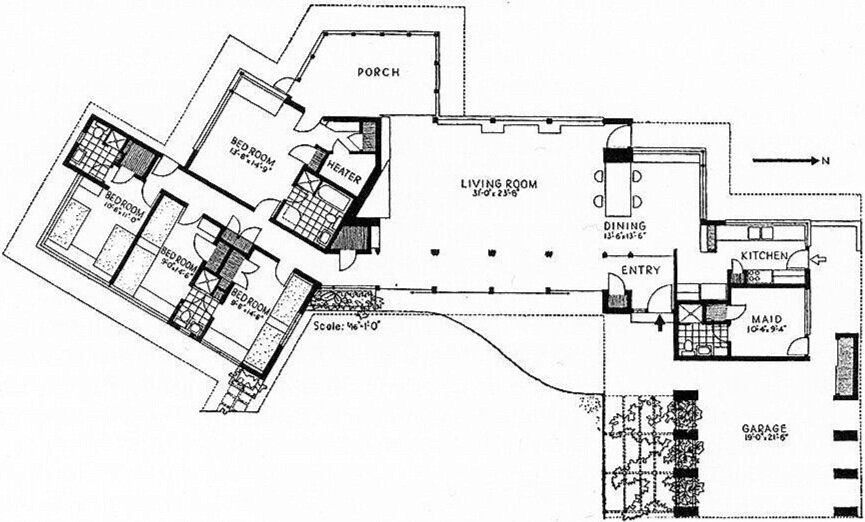
The plan of the Twitchell Residence: Ralph Twitchell’s residence in Sarasota, Florida, a design of 1941. It is Paul Rudolph’s second built design, and his first in association with the senior architect. What might one learn (or speculate about) from studying such a floor plan?
The plan of the Twitchell Residence: Ralph Twitchell’s residence in Sarasota, Florida, a design of 1941. It is Paul Rudolph’s second built design, and his first in association with the senior architect. What might one learn (or speculate about) from studying such a floor plan?

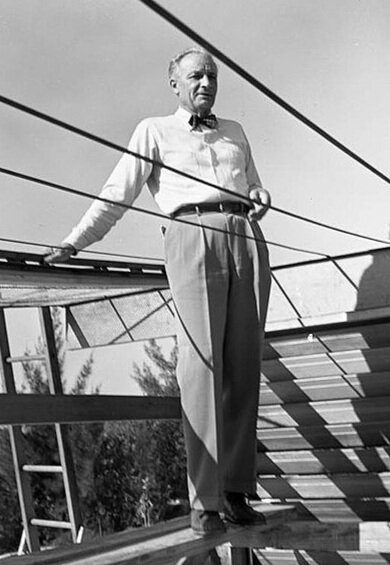
Ralph Spencer Twitchell, Architect (1890-1978)

Ralph Spencer Twitchell, Architect (1890-1978)

RALPH TWITCHELL

It is the birthday of Ralph Spencer Twitchell (July 27, 1890 – January 30, 1978)—and we take this moment to celebrate this architect, one who not only played a key part in the life and career of Paul Rudolph, but who contributed to the Sarasota community.

TWITCHELL AND RUDOLPH

Even to those who have a deep interest in the history of Modern architecture, Ralph Twitchell is not known much beyond a brief summary that peppers many biographies of Rudolph. What one often reads is that the senior architect gave Rudolph his start (Twitchell was nearly 3 decades older than Rudolph), bringing the young designer into his practice, and (and, as soon as Rudolph obtained his architectural license, taking him into partnership).

To this alliance, Twitchell is seen as having contributed an established position in the Sarasota community, a track record of successful projects, a way with clients, and a firm knowledge of construction—and Rudolph was the ultra-talented (and hardworking and prolific) youthful design genius. A productive period ensued, with many houses built and proposed—some of them among Paul Rudolph’s most striking designs, including: the widely-published Healy (“Cocoon”) House; the innovative Knott Residence; and the proposal for a complex of houses for the Revere Development (which showed Rudolph working skillfully within the vocabulary of Mies van der Rohe's “courtyard house” design experiments).

The Knott Residence, proposed for Yankeetown, Florida
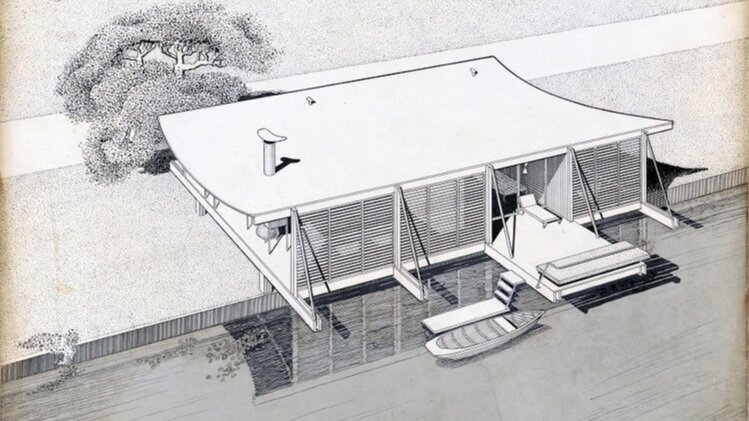
The Knott Residence, proposed for Yankeetown, Florida

The Healy (“Cocoon”) House, built in Sarasota, Florida
The Healy (“Cocoon”) House, built in Sarasota, Florida

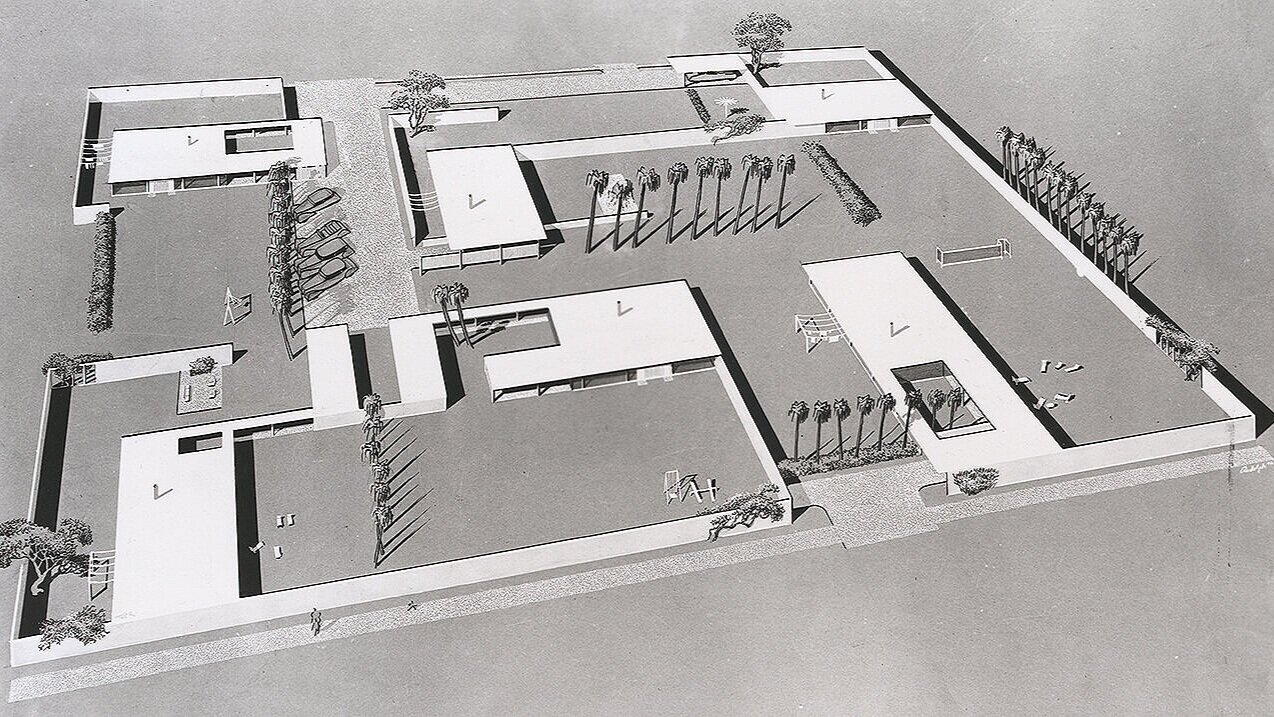
The Revere Development,  proposed for Siesta Key, Florida

The Revere Development, proposed for Siesta Key, Florida

But, after about a half-decade of intense and successful work, Rudolph splits with Twitchell—apparently after a disagreement. Rudolph went on to found his own firm, attaining amazing success in the coming decades—both professionally and artistically.

ARCHETYPAL STORIES

So the impression one gets, from this highly condensed duo-biographical sketch, is that Twitchell provided the assets of the establishment: boring but practical and useful; whereas Rudolph injected the artistically energetic ingredients which really made their work interesting. Then, ultimately, it is the young genius who rebels and pursues his own path: an adventurous road to great achievement. From then on, we hear no more of Twitchell.

It is an appealing story, with its depiction of the talented and irrepressible “rebel”—and one wouldn’t have to search very hard into the work of Joseph Campbell to find, within the world of comparative mythology, that this is tale that can be found in all ages and cultures across the globe: the archetypal “Hero’s Journey”.

DEEPER AND BROADER

But, if there’s one thing that historians learn, it is that no story is simple—and, if one has the interest to dig, and to challenge the received wisdom, all stories keep opening up new questions and possibilities. The honest historian always wants—needs—to go deeper into the evidence, and look ever more broadly at what might have influenced/created a situation.

So let’s see if we can open-up (or as historians say, “unpack”) the above story. To do that, let’s consider the Twitchell Residence: how much is Twitchell and how much is Rudolph? We’ll probably never know the exact ratio and nature of their contributions to the design, but we can consider some of the factors that might have affected its planning and form. Items to consider include:

  • This is Twitchell’s personal home—and it is a natural feeling to be particularly focused on the design of one’s own home—and that’s especially true for architects! No matter how talented his young associate (Rudolph), is it plausible that a senior architect would hand-over the full responsibility for the architecture of his own home to someone else? Or is it more likely that he had important and key input into the design?

  • The building was completed in 1941. War is raging in Europe and Asia, and tremors of possible US involvement in the war—and a general national nervousness—are pervasive. Twitchell was old-enough to recall what happened during the previous World War: labor and materials had been in short-supply, and most construction was put on-hold for the duration of the fighting. Twitchell might have wanted to get his house built while it was still possible to do soand he’d have only one chance to get it right. So—for this one chance—would he completely abdicate design responsibly for that to another?

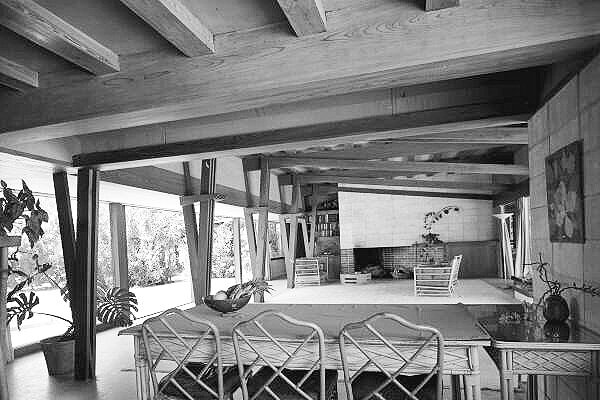
  • There are many striking similarities between the Living-Dining area of the Twitchell Residence, and the famous drafting room at Frank Lloyd Wright’s Taliesin West—too many to be just a coincidence [See comparison photos, below.]

  • There are other Wrightian aspects of the Twitchell House: the compactness of the bedrooms (Wright thought bedrooms should be small, almost cabin-like, and primarily for sleeping—and that residents would/should spend their time outside of them); Dining and Living Room Areas that merge into each-other; the primacy of a solid, prominent fireplace wall, as one of the defining elements of the Living Room; and the set of visually solid piers which define the parking area, which create a strong entry sequence to the house.

  • We know that Paul Rudolph was an ardent admirer of Wright—and that visiting a Wright home, at an early age, had been a decisive moment in Rudolph’s development. Rudolph’s devotion to Wright is something he’d acknowledge for his whole life. But—

The drafting room of Frank Lloyd Wright’s Taliesin West  —and iconic part of the Taliesin complex. Key features—the ones that create it’s overall character are: the open, uninterrupted space; the inclined ceiling; the expressed structure inclined beams across that ceiling: the directionality of the space, with one side opening to the exterior; the V-shaped, angled columns, at the open side of the room, which support the beams above.
The drafting room of Frank Lloyd Wright’s Taliesin West —and iconic part of the Taliesin complex. Key features—the ones that create it’s overall character are: the open, uninterrupted space; the inclined ceiling; the expressed structure inclined beams across that ceiling: the directionality of the space, with one side opening to the exterior; the V-shaped, angled columns, at the open side of the room, which support the beams above.

Both Twitchell and Paul Rudolph were aware of Wright’s work—and, from a young age, Rudolph was especially influenced by Wright’s designs (something he’d warmly acknowledge all his life). Above is the main living space of the Twitchell Residence: one is looking South into the Living Room, with the Dining area in the foreground. Was it Rudolph who urged that it follow so many of the features of Wright’s Taliesin drafting room?

Both Twitchell and Paul Rudolph were aware of Wright’s work—and, from a young age, Rudolph was especially influenced by Wright’s designs (something he’d warmly acknowledge all his life). Above is the main living space of the Twitchell Residence: one is looking South into the Living Room, with the Dining area in the foreground. Was it Rudolph who urged that it follow so many of the features of Wright’s Taliesin drafting room?

  • But Twitchell could equally have been aware of Wright. Frank Lloyd Wright was a relentless self-promoter and had been widely published for decades—so it would be impossible for any architect, of Twitchell’s era and age, to be ignorant of Wright. Further, given Wright’s decades of fame, Twitchell’s awareness of Wright’s work would have started well before he met Paul Rudolph.

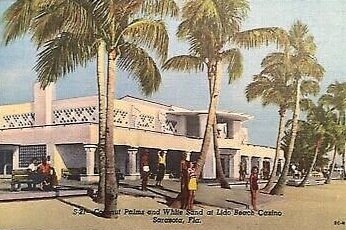
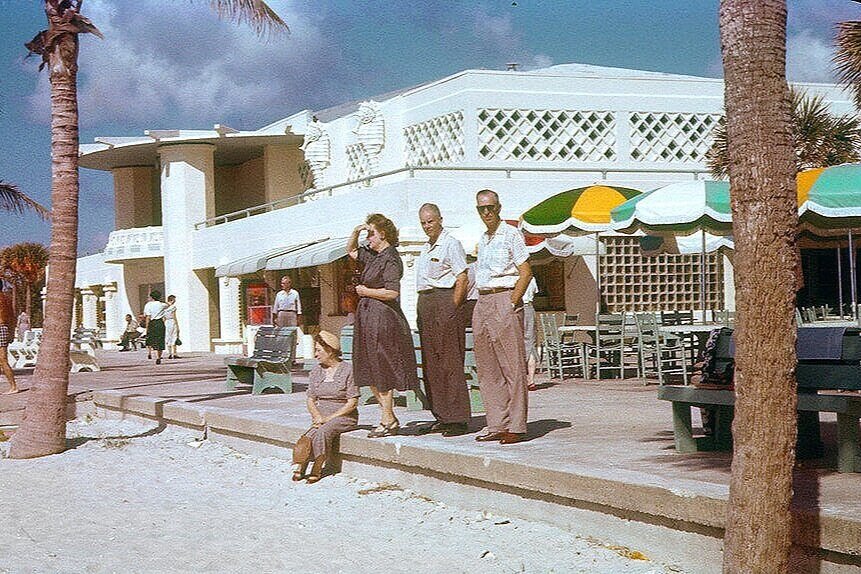
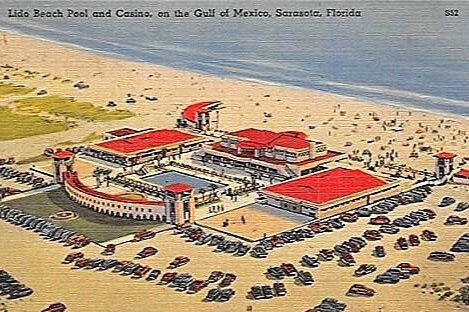
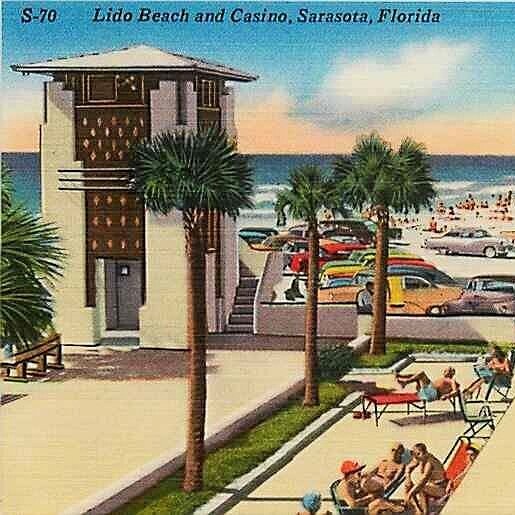
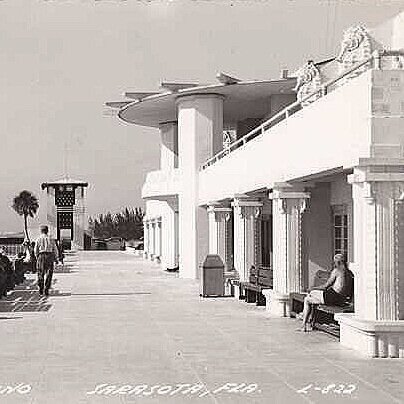
  • But, beyond familiarity, there’s a strong affinity between Wright’s work and another Twitchell project: one of his largest works, the Lido Beach Casino in Sarasota. The complex—an extensive structure with multiple parts and functions—was built in 1940, and probably planned in the previous year(s)—well before Rudolph was engaged by Twitchell. It was a venue for beach and pool swimming, dining, dancing, a nightclub, and shopping—and events of all kinds (beauty contests, swim meets, school and social) were held there.

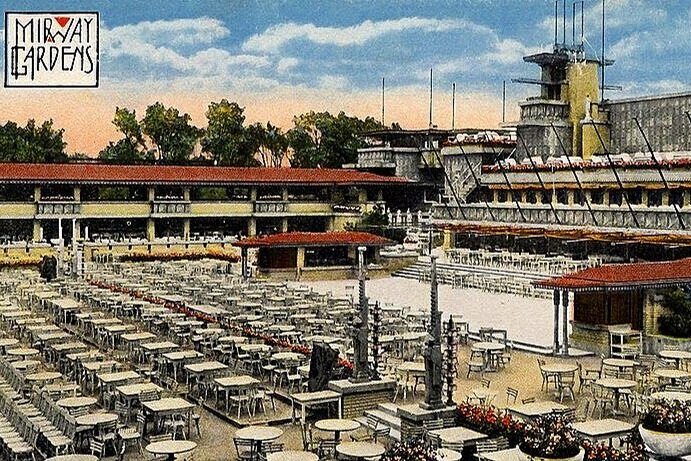
  • The project bears a striking similarity to Wright’s Midway Gardens: excluding swimming, both the Lido Beach Casino and Midway are of similar scale, encompass nearly matching programs, and were aimed at the same type of audience.
Frank Lloyd Wright’s Midway Gardens in Chicago
Frank Lloyd Wright’s Midway Gardens in Chicago

Ralph Twitchell’s Lido Beach Casino in Sarasota

Ralph Twitchell’s Lido Beach Casino in Sarasota

  • The two entertainment complexes share a “parti" (their basic architectural organization): both having a large, central, open space—which is enclosed and defined by structures for various functions, and which is anchored at one side by a taller main building.
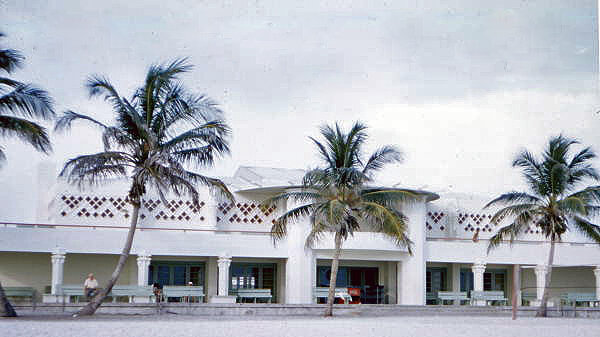
Beachside view of the Lido Beach Casino—a view from circa 1956—showing the main, central structure that visually anchored the complex.

Beachside view of the Lido Beach Casino—a view from circa 1956—showing the main, central structure that visually anchored the complex.

  • Other aspects of the building display possible Wrightian influences, such as—-

  • The pronounced horizontality of the composition—both overall, and in its elements: the low, hipped roofs of the two towers (and in the linear detail at their mid-areas), and the disc-shaped cantilevered roof at the center of the beach elevation

  • The detailing of the columns

  • The use of block—and prominently including a pattern of penetrations in the block masonry walls

  • The creation of deep colonnades—not only offering protection from the sun, but also creating dramatically shadowed areas

  • The almost Mayan “introverted” feel of the building—like Wright’s Hollyhock House, due to the solidity of the massing and of individual elements like the columns

  • The display/celebration of structure—as in the rafters over the beachside elevation’s central roof, the hefty piers supporting that roof, and the line of columns

  • Altogether, one cannot ignore the possible Wright influences in this Twitchell-before-Rudolph project.

  • So the question becomes: If we see Wrightian influences here, could Twitchell also have brought such design input into his work with Rudolph?
postcard with tower.jpg
postcard%2Bwith%2Bcolumns.jpg
Sarasota-FL-Palms-White-Sands-Lido-Beach.jpg
lido another view.jpg

WITHER RALPH TWITCHELL?

In the standard history of their Twitchell and Rudolph’s partnership, Twitchell is known as the “business partner” -or- the “public face” (who charmed clients) -or- “the [construction] site guy”. But though he was all those things (and, apparently, excelled in those roles), perhaps he was more than that. He had an extensive career both before and after his partnership with Rudolph, and—as looked-at in the above two cases (his 1941 Residence, and the Lido Beach Casino) there are reasons to contend that he might have had more of a design talent and sensibility than he’s usually given credit for. The import of this is: his input into projects in the Twitchell and Rudolph partnership might possibly have been stronger than previously assumed.

THE HISTORIAN’S PERSPECTIVE

To be fair to both sides, we should mention that we do have Paul Rudolph’s counter-testimony to such an idea (Rudolph said that whatever was good and interesting in their work was attributed to himself alone!). We don’t mean to assail the integrity of Rudolph’s claim—but part of the work of history is to question such self-contained, categorical statements. “Meta-narratives”—the big, central stories by which we’ve long understood the course of events (at world, local, and personal scales)—are never quite inclusive-enough of all the facts: there always dissonant evidence (“out-of-place artifacts”), clues, even “hints” that stubbornly won’t go away, and a real historian will never ignore them. So the question of Twitchell’s ability and input as a designer is an open one.

CELEBRATING TWITCHELL

So today,. on his birthday, we give Twitchell some renewed attention and consideration—”giving him a little love” that he’s rarely received in the soundbite assessment that he often gets.

A talented, energetic, and enterprising figure—and one who may have had more focus on design than usually acknowledged—it is worth celebrating this important architect: RALPH SPENCER TWITCHELL

Ralph Twitchell (center) consulting with builders on-site. What’s intriguing about this image is that it shows the Healy (“Cocoon”) House under construction—and one can see the catenary metal straps, upon which house’s curved roof (its most pronounced feature) was to be suspended. Healy was the most famous building completed during Twitchell and Rudolph’s partnership, but after Rudolph departed, Twitchell continued to practice until at least the mid-1960’s, and lived until 1978—long enough to see his former partner, Rudolph, achieve stratospheric success and fame. One wonders what Twitchell thought of that: was he jealous, bitter, tranquil—or glad that he’d fostered such a profound and prodigious talent as Paul Rudolph?

Ralph Twitchell (center) consulting with builders on-site. What’s intriguing about this image is that it shows the Healy (“Cocoon”) House under construction—and one can see the catenary metal straps, upon which house’s curved roof (its most pronounced feature) was to be suspended. Healy was the most famous building completed during Twitchell and Rudolph’s partnership, but after Rudolph departed, Twitchell continued to practice until at least the mid-1960’s, and lived until 1978—long enough to see his former partner, Rudolph, achieve stratospheric success and fame. One wonders what Twitchell thought of that: was he jealous, bitter, tranquil—or glad that he’d fostered such a profound and prodigious talent as Paul Rudolph?


IMAGE CREDITS

NOTES:

The Paul Rudolph Heritage Foundation gratefully thanks all the individuals and organizations whose images are used in this non-profit scholarly and educational project.

The credits are shown when known to us, and are to the best of our knowledge, but the origin and connected rights of many images (especially vintage photos and other vintage materials) are often difficult determine. In all cases the materials are used in-good faith, and in fair use, in our non-profit, scholarly, and educational efforts. If any use, credits, or rights need to be amended or changed, please let us know.

When/If Wikimedia Commons links are provided, they are linked to the information page for that particular image. Information about the rights for the use of each of those images, as well as technical information on the images, can be found on those individual pages.

CREDITS, FROM TOP-TO-BOTTOM and LEFT-TO-RIGHT:

Floor plan of the Twitchell Residence: © The Estate of Paul Rudolph, The Paul Rudolph Heritage Foundation; Photo portrait of Ralph Twitchell: by Joseph Steinmetz, from the State Library & Archives of Florida, via Wikimedia Commons; Perspective renderings by Paul Rudolph of the Knott Residence, Healy (“Cocoon”) House, and the Revere Development: © The Estate of Paul Rudolph, The Paul Rudolph Heritage Foundation; Taliesin West drafting room: photo by Steven C. Price, via Wikimedia Commons [Note: to help facilitate comparisons between this space and the Twitchell Residence Living Room (the next picture), this photo of the drafting room has been flipped, and color was removed.]; Ralph Twitchell Residence Living Room: by Joseph Steinmetz, from the State Library & Archives of Florida; Midway Gardens: vintage post card. circa 1915, via Wikimedia Commons; Beachside view of Lido Beach Casino, circa 1956: photo, circa 1956, via Wikimedia Commons; Post cards and photos of Lido Beach Casino: vintage images; Photo portrait of Ralph Twitchell at Healy construction site: by Joseph Steinmetz, from the State Library & Archives of Florida, via Wikimedia Commons
Architecture as a "Labor of Love" (or just labor?)

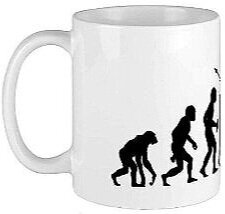
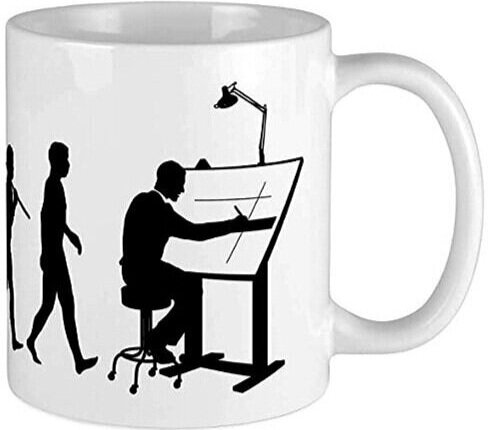
This mug, with clever graphics designed by Spaghettee, is titled “The Evolution Of Man - Architect”—and while the designer’s meaning is clear (about the culmination of evolution), perhaps another interpretation can be….

This mug, with clever graphics designed by Spaghettee, is titled “The Evolution Of Man - Architect”—and while the designer’s meaning is clear (about the culmination of evolution), perhaps another interpretation can be….

that it’s also asking a serious question:  “Is this the outcome to which all existence leads: architectural labor?”

that it’s also asking a serious question: “Is this the outcome to which all existence leads: architectural labor?”

The life of an architect is associated with long hours (and often no full weekends, and putting-off vacations—and, if they’re taken at all, they’re shortened). Working long days into late nights seems frequent in architectural offices—an aspect of professional culture that goes beyond showing one’s enthusiasm or commitment—and which can manifest in health challenges and life-imbalance.

LONG HOURS AND THE CULTURE OF THE “CHARETTE”

Late at night at the Yale Art & Architecture Building—and the lights are still burning. This view is from 1963, which is during the period (1958-1965) when Paul Rudolph was chair of Yale’s School of Architecture. He, along with the students (working at their drawing boards) might well have been in the building when this photograph was taken.

Late at night at the Yale Art & Architecture Building—and the lights are still burning. This view is from 1963, which is during the period (1958-1965) when Paul Rudolph was chair of Yale’s School of Architecture. He, along with the students (working at their drawing boards) might well have been in the building when this photograph was taken.

Among architecture students, there’s a saying:

You can always tell which building on campus is the Architecture School: it’s the only one where the lights are on all night.

The practice of endless hours, logged by architects, certainly seems to start in architecture school: most students remember working through the weekend and holidays, and the nights that stretch into mornings.

This is not a new phenomenon, and such behavior was known in 19th century: it is associated with the French art and architecture school, the École des Beaux-Arts in Paris. The practice has the testimony of language in the term “charrette” (a French word meaning cart or wagon.) At the end of an school assignment, a cart was sent around to the architecture school studios to collect the student’s work. Allegedly, students would jump onto the cart—even as it was wheeled away—to keep working on their designs until the last moment (when the work was finally delivered for use by the jury.) Out of this came phrases for drastic stretches of work to meet a deadline: one is said to be “working en charrette” or “doing a charrette.”

Tigerman’s memoir includes his reflections on Rudolph—as teacher, architect, and man—and describes the long hours that were expected of architecture school students.

Tigerman’s memoir includes his reflections on Rudolph—as teacher, architect, and man—and describes the long hours that were expected of architecture school students.

Late in his life, Stanley Tigerman (1930-2019) released a pulls-no-punches memoir, Designing Bridges to Burn. The book is frank about Tigerman’s career, life, and the figures he encountered—-and that includes writing about his years as a student at Yale’s School of Architecture. [He was there in the middle of the era when Paul Rudolph was chair of the department, and he graduated in 1961.]

In Tigerman’s memoir, he tells of the time that he was, simultaneously, both a full-time student and also a part-time employee at Paul Rudolph’s combined office & residence on High Street (which was located not far from the school.) The book’s passages, below, are revealing for what they say about the time & labor commitment Rudolph expected of students, as well as about Rudolph’s own work ethic:

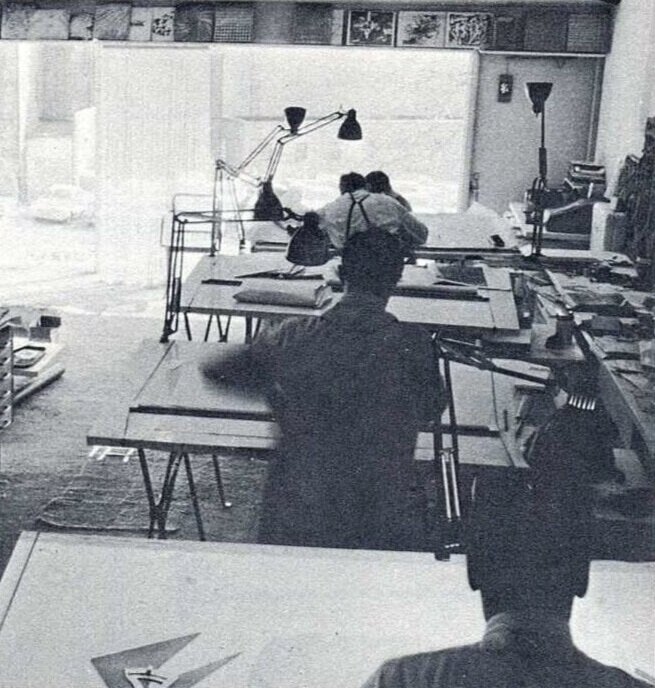
Not far from the Yale’s architecture school (where Paul Rudolph was chair of the department) was Rudolph’s architecture office on High Street: one large, loft-like space, situated in the top of a vintage building owned by the architect (to which Rudolph also added his residence.) Here, Tigerman had a part-time job working for Rudolph—as did some other Yale students. The commitment expected of students (shown in long hours, working day and night) was modeled for them by Paul Rudolph’s own work ethic.

Not far from the Yale’s architecture school (where Paul Rudolph was chair of the department) was Rudolph’s architecture office on High Street: one large, loft-like space, situated in the top of a vintage building owned by the architect (to which Rudolph also added his residence.) Here, Tigerman had a part-time job working for Rudolph—as did some other Yale students. The commitment expected of students (shown in long hours, working day and night) was modeled for them by Paul Rudolph’s own work ethic.

“In those years, the architecture studio terminated its daily activities promptly at 2 am when the Yale radio station blared out the Yale anthem “Bright College Years.” Every night in an unanticipated explosion of collegiality, we all rose from our drafting-board stools to belt out Yale’s alma mater. Many of our group then reconvened at My Brother’s Place, the local architecture school hangout on Chapel Street across from the art school at Street Hall. I instead went to work at Rudolph’s atelier around the corner on High Street”

“Working in Rudolph’s office was an eye-opener. For those of us who thought that we had a strong commitment to architecture, what we engaged in was child’s play next to Rudolph’s personal work ethic. He toiled tirelessly night and day, intermittently striding the one short block from the studio to the architecture school whenever the spirit moved him. One never knew when he would show up. . . . but God forbid if one’s drafting board was unmanned when he arrived.”

“Working in Rudolph’s studio was a race against time for the rest of us as well. I thrive on it, but there was a price to pay. I was frequently in a state of sleep deprivation and looked it. No matter, I was at my drawing board in the architecture-school studio every morning when it reopened at 9 am, as were all of us.”

WORK-LIFE BALANCE?

Of course, such behavior doesn’t end with graduation from school. In the last couple of decades, the issue of “work-life balance” has become a rising subject of debate—including within the architectural profession. Sometimes that imbalance is self-imposed—and in a beautiful memorial tribute to his old teacher, employer, and friend, Tigerman assessed this aspect of Rudolph: “His personal tragedy lay in his expectations that architecture would offer him that which only life can deliver.”

The problems of architectural work are not limited to long hours (though that’s one of the most high-profile symptoms)—and some researchers and thinkers have been looking into the nature of architectural “labor.”

WAGNER AND DEAMER ON THE CULTURE OF ARCHITECTURE

wagner+headline.jpg

We’re always interested in what Kate Wagner has to say. It would be too limited to call her an architecture critic, as that would seem to restrict her judgement to buildings (though she certainly addresses architectural design.) Kate Wagner is also one of the most astute observers of architectural culture: the overall systems, contexts, relationships, and assumptions from which our built environment emerges.

In several past posts we’ve pointed to articles Wagner has written—and reflected on and the issues she raised. These have ranged from the hegemony of open space planning (and the challenges it entails) -to- Brutalism (and its larger meanings)—a topic which she’s taken on again and again.

In an article in The Architect’s Newspaper, titled “People Power, Kate Wagner reviewed Peggy Deamer’s recent book, ARCHITECTURE AND LABOR. Wagner not only reports on the book, but also contributes her own perceptions and insights.

ARCHITECTS’ WORK: REWARDING (BUT UN-REWARDED?)

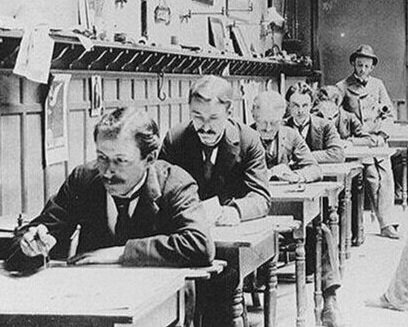
A view of the architectural drafting room of Ferry & Clas—probably from the late 19th Century.

A view of the architectural drafting room of Ferry & Clas—probably from the late 19th Century.

The book author, Peggy Deamer, is an architect and professor emerita of architecture at Yale—and the founding member of The Architecture Lobby, which describes itself as:

“. . . .an organization of architectural workers advocating for the value of architecture in the general public and for architectural work within the discipline. It believes that the work architects do – aesthetic, technical, social, organizational, environmental, administrative, fiduciary – needs structural change to be more rewarding and more socially relevant. As long as architecture tolerates abusive practices in the office and the construction site, it cannot insist on its role in and for the public good.”

And, it that spirit, Deamer has written ARCHITECTURE AND LABOR. In the introduction, she states her position and intentions for the book:

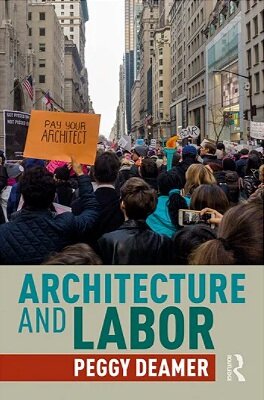
The new book by Peggy Deamer uses a provocative image: note the sign carried by the demonstrator in the cover photo..

The new book by Peggy Deamer uses a provocative image: note the sign carried by the demonstrator in the cover photo..

“This book hopes to fill a huge and consequential gap in architectural thought and practice: the acknowledgment of the fact that architects labor—that our time in the office is work, that this work is monetized, and that monetization is part of our larger, national, economic equation. We might think that our design activity is art and not work; we might assume that we offer our spatial gifts to society from some exceptional position outside society itself; we might hope that our value to society transcends commerce—but no. We are part of the labor force. . . .”

And:

“. . -. .The fact that architects themselves are startled by the term "architectural labor" indicates how late, compared to professions like art, film, journalism, couture, and literature, we are to a substantive discussion of labor and its value. This book is not a how-to guide to creating robust professional practices. It is rather an examination of our befuddled concept of "architectural work" and that befuddlement's negative consequences on our various institutions.”

THE REALITIES OF ARCHITECTURAL WORK

hand+holding+a+pen.jpg

Kate Wagner, in her review-essay on the book (and the issues it raises), gives her view of the actuality of the day-to-day work of architecture:

“Most of the practicing architecture is drudgery. . . .Most of the time, they’re sitting at the computer wrangling something called Building Information Management or drawing sections of insulation at a desk with several other people doing the same thing. This is not the creative calling one was promised as a 19-year-old. This is work, plain and simple. . . .”

And then points-out the disjunction between that reality, and how architects (and their staffs) view themselves and their position:

“And yet architects do not see themselves as workers. They see themselves as temporarily disadvantaged creatives, somehow distinct from the construction laborers who turn their drawings into reality. When architects do begin to think of themselves as workers, they open themselves up to a wide range of political possibilities, ones with profound potential to change the practice and face of architecture. . . .”

“We as a field are thus fortunate that there are now works like Peggy Deamer’s Architecture and Labor that help clarify, in no uncertain terms, our unflattering rules of engagement as participants in capitalist society. . . .”

“Much of Deamer’s work could be characterized as disciplinary myth-busting. . . .with a disquisition on the nature of architectural labor as labor, aiming to tear down the firewall between architects and the rest of the AEC world, or as Deamer succinctly puts it, “Architects design, contractors build; we do art, they do work.”

She (and the book) also point out:

“In distinguishing themselves from the building trades, architects not only fail to grasp the notion of their own precarity as laborers but also let slip the financial and wellness opportunities available to those trades through unions and different structures of ownership.”

PRAISE FOR THE BOOK—AND A CALL TO ACTION

Kate Wagner concludes with high assessment of Deamer’s book, Architecture and Labor—and an incitement to ask questions:

“Deamer does a wonderful job of answering questions related to the eldritch legal and organizational setbacks tied to the specific field of architecture. She asks and answers questions of labor—what it means in terms of architectural practice, how architects’ conceptions of themselves form over time, the history of architectural labor and its organizing bodies—but the time now has come to ask questions about labor power. Those are collective questions, and the only way to truly answer them is through action.”

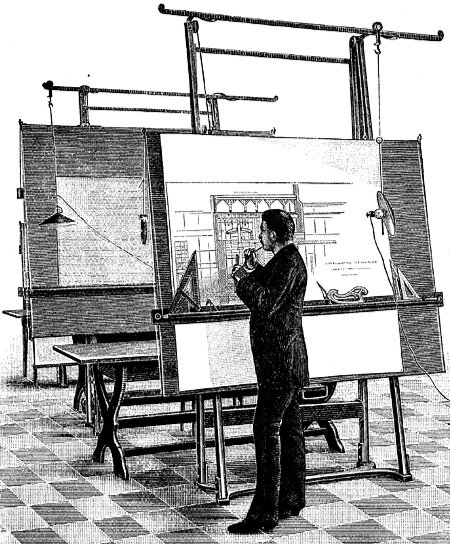
An architect at his drawing board: an engraving published in 1893, illustrating an article about a new model of upright drawing board. With its counter-weighted parallel bar (replacing the traditional T-Square), built-in drafting tools ledge, and movable electric light, this would have been high-tech for it’s era. While this might be seen as improved equipment for the architect, the kind of analysis which Wagner an Deamer offer could lead one to characterize this as a way to increase labor productivity. Note that work would have been done standing-up, a practice more often found in European architecture and engineering offices.

An architect at his drawing board: an engraving published in 1893, illustrating an article about a new model of upright drawing board. With its counter-weighted parallel bar (replacing the traditional T-Square), built-in drafting tools ledge, and movable electric light, this would have been high-tech for it’s era. While this might be seen as improved equipment for the architect, the kind of analysis which Wagner an Deamer offer could lead one to characterize this as a way to increase labor productivity. Note that work would have been done standing-up, a practice more often found in European architecture and engineering offices.

BOOK INFORMATION AND AVAILABLITY:

Title:  Architecture and Labor

Author:  Peggy Deamer

Publisher:  Routledge

Format:  Paperback, 9” x 6”, 192 pages,

Illustrations: 65 black & white illustrations

ISBN:  9780367343507

Alternative Formats:  both hardcover and eBook versions are also available.

Publisher’s page for the book:  here

Amazon page for the book:  here

Barnes & Noble page for the book:  here


IMAGE CREDITS

NOTES:

The Paul Rudolph Heritage Foundation gratefully thanks all the individuals and organizations whose images are used in this non-profit scholarly and educational project.

The credits are shown when known to us, and are to the best of our knowledge, but the origin and connected rights of many images (especially vintage photos and other vintage materials) are often difficult determine. In all cases the materials are used in-good faith, and in fair use, in our non-profit, scholarly, and educational efforts. If any use, credits, or rights need to be amended or changed, please let us know.

When/If Wikimedia Commons links are provided, they are linked to the information page for that particular image. Information about the rights for the use of each of those images, as well as technical information on the images, can be found on those individual pages.

CREDITS, FROM TOP-TO-BOTTOM:

“The Evolution Of Man - Architect” Mug : from the Amazon page for that item; Yale Art & Architecture Building at night: courtesy of © J. Paul Getty Trust. Getty Research Institute, Los Angeles (2004.R.10); “Designing Bridges To Burn” book cover: from the Amazon page for that book; Interior of Paul Rudolph’s architecture office on High Street in New Haven: photo by Yuji Noga, from the archives of the Paul Rudolph Heritage Foundation; Ferry & Clas drafting room: via Wikimedia Commons; “Architecture and Labor” book cover: by the the publisher, Routledge; Engraved drawing of of a hand on a drawing board, with a ruling pen: from A Textbook on Ornamental Design (1901), via Wikimedia Commons; Architect standing at Drawing Board: a wood engraving published on May 25, 1893 in Teknisk Ukeblad, an engineering journal in Norway. It illustrates an article about a new kind of upright drawing board delivered by the firm J. M. Voith in Heidenheim a. d. Brenz (in south Germany), via Wikimedia Commons.